What Can You Do About 24-Hour Tunnelling Noise Near Your Home?
Quick answer
If construction or tunnelling noise runs through the night near your home, keep a dated log, raise it with the contractor first, then contact your council's Environmental Health team. Councils can control hours, machinery and noise levels under the Control of Pollution Act 1974, section 60, and noise including vibration can be a statutory nuisance under the Environmental Protection Act 1990.
Key takeaways
- Residents near Dŵr Cymru's 24-hour tunnelling at Hailey Park, Llandaff North, Cardiff, report noise, vibration and lost sleep (Nation.Cymru/LDRS, 17 October 2026).
- Under the Control of Pollution Act 1974, section 60, a council can set hours, plant and noise limits for construction work.
- Noise, including vibration, can be a statutory nuisance under the Environmental Protection Act 1990, section 79, and councils must investigate residents' complaints.
- Contractors must use best practicable means; in Wales BS 5228-1 and BS 5228-2 are approved codes of practice.
- Acoustic barriers help with airborne noise only, and lab Rw ratings overstate real on-site reduction.
If drilling or tunnelling near your home runs through the night, you are not imagining the problem, and you are not powerless. Councils can control how construction work is carried out, including hours, machinery and noise levels, under the Control of Pollution Act 1974, section 60. Noise, including vibration, can also be a statutory nuisance under the Environmental Protection Act 1990.
Round-the-clock work is hard to live with. Lost sleep builds up quickly, and it is worse when you feel nobody told you it was coming. That is exactly what residents near a sewer tunnelling site in Cardiff say they are going through.
In this article you'll learn:
- What is happening at Hailey Park in Llandaff North, and why the work runs 24 hours a day
- What your rights are when construction or tunnelling noise carries on at night
- How to complain in the right order so your complaint is taken seriously
- What a contractor can practically do about noise, and where those measures fall short
What is happening at Hailey Park?
Dŵr Cymru Welsh Water is building a pumping station connection at Hailey Park in Llandaff North, Cardiff. According to the Local Democracy Reporting Service, published by Nation.Cymru on 17 October 2026, the link will carry sewage from the planned 7,000-home Plasdŵr development across the River Taff to the existing sewer network and on to Cardiff Wastewater Treatment Works.
The scheme was approved in 2022 but was delayed by a legal challenge and by machinery damaged on a waterlogged site. Permission for round-the-clock tunnelling was granted in September 2026, and drilling started later that month.
Residents told the reporter about constant noise and vibration, broken sleep, headaches and earaches. One said she had stayed elsewhere to get away from it. Others criticised poor communication and a lack of consideration for neighbours and wildlife. When the reporter measured the noise on site, it was about 50 decibels, and it could still be heard at the Melingriffith Water Pump, just under half a kilometre away.
Dŵr Cymru said it recognises the impact on some residents. It said 24-hour tunnelling is needed to do this phase safely and to avoid further delays, and that acoustic barriers and continuous noise monitoring are in place around the site. It added that it will keep working with its contractor and the community.
That is both sides as reported. The rest of this article is about what you can do if you are in a similar position, wherever you live.
Is construction work allowed to run 24 hours a day?
Sometimes, yes. There is no single national rule that bans night work. Councils set or agree hours locally. For example, North Yorkshire Council's guidance gives typical hours of 8am to 6pm on weekdays and 8am to 1pm on Saturdays, with no work on Sundays or bank holidays, and says noisy work should not happen outside those hours without prior agreement.
Some jobs, such as tunnelling, rail work or roadworks, are often agreed for nights or continuous running because stopping halfway is unsafe or traffic makes daytime work impractical. Agreed does not mean anything goes, though. The contractor is still expected to keep noise as low as it reasonably can.
What powers does the council have?
Section 60 notice: a legal notice from the council that sets conditions on how construction work is carried out. Under the Control of Pollution Act 1974, section 60, a notice can specify which plant or machinery may or may not be used, the hours of work, and maximum noise levels at given points or times. Breaching it without reasonable excuse is an offence. The contractor can appeal to a magistrates' court within 21 days.
Section 61 consent: an agreement a contractor can apply for before work starts, setting out its methods and noise controls. The council must decide within 28 days. Working within a consent is a defence against prosecution for breaching a section 60 notice.
Statutory nuisance: noise (including vibration) from premises that is prejudicial to health or a nuisance, under the Environmental Protection Act 1990, section 79. If a resident complains, the council must take reasonably practicable steps to investigate. If it is satisfied a nuisance exists or is likely to recur, section 80 requires it to serve an abatement notice, although for noise it may first try to persuade the person responsible to deal with it.
What does "best practicable means" mean?
Best practicable means (BPM): the reasonably practicable steps a business must take to minimise noise, taking account of local conditions, technical knowledge and cost. It covers how plant is chosen, maintained and operated. If a business is prosecuted for not complying with a noise abatement notice, showing it used BPM can be a defence. Councils must also have regard to BPM when setting section 60 conditions.
In Wales, the Welsh Ministers have approved BS 5228-1:2009+A1:2014 (noise) and BS 5228-2:2009+A1:2014 (vibration) as codes of practice for construction and open sites. Councils and contractors use these to judge what reasonable noise control looks like.
How do I complain about construction noise effectively?
It depends on how the work is permitted, but the order below works in most cases.
| Step | Who to contact | What to have ready | What to expect |
|---|---|---|---|
| 1. Log it | Nobody yet | Dates, times, what you heard or felt, effect on you, recordings | A record that shows a pattern, not a one-off |
| 2. Contractor | Site manager or community helpline | Your log and a clear, polite request | A reply, an explanation of hours, sometimes changes |
| 3. Council | Environmental Health (noise team) | Your log and the contractor's reply | Investigation, possible site visit, monitoring |
| 4. Escalate | Your councillor or the developer's senior team | Everything above | Pressure on hours, methods or communication |
A few practical points:
- Start a noise log now. Note start and finish times, the type of noise (drilling, reversing alarms, generators, deliveries), and how it affects you, such as being woken at 2am. Our noise log makes this easier.
- Ask what has been agreed. Ask the contractor or council whether there is a section 61 consent or other conditions, and what hours they allow.
- Report vibration as well as noise. The law treats vibration as part of noise for statutory nuisance purposes.
- Keep it factual. A calm, specific complaint is easier for Environmental Health to act on than an angry one.
What can the contractor practically do?
Sounds simple enough, right? Put up a fence and the noise goes away. In practice, the options work best in combination, and each has limits.
| Measure | Helps with | Limitations |
|---|---|---|
| Scheduling | Moving the noisiest tasks, deliveries and reversing into the day | Not always possible for continuous processes like tunnelling |
| Quieter methods and plant | Lower noise at source, e.g. electric or better-maintained plant | May not exist for every task |
| Plant shrouds and enclosures | Fixed noisy kit such as generators, pumps, breakers | Need ventilation and access for maintenance |
| Temporary acoustic barriers | Airborne noise between the source and homes | Do nothing for vibration through the ground |
| Communication | Trust, warning of noisy nights, a working helpline | Does not reduce noise by itself |
Are acoustic barriers enough?
On their own, usually not. A barrier deals with sound travelling through the air. If much of what you notice is vibration, or a low rumble coming up through the ground, a barrier will not fix that. The answer there is methods, plant choice and monitoring.
Where airborne noise is the issue, how the barrier is specified matters more than whether one is up at all:
- Height: it must block the line of sight between the noise source and the homes affected. Sound bends over the top of a low barrier.
- No gaps: gaps at the base or between panels let sound straight through.
- Close to the source: a barrier placed near the noisy plant protects a wider area than one at the site boundary.
- Absorptive face: a sound-absorbing surface facing the works reduces sound bouncing back and forth.
- Length: sound also travels round the ends, so the barrier needs to extend beyond the source.
Rw (weighted sound reduction index): a laboratory rating of how much sound a panel stops passing through it. It is useful for comparing products, but it is not the reduction you will hear at home. On a real site, sound goes over the top and around the ends, so the actual benefit is lower and depends on layout.
αw (weighted sound absorption coefficient): a rating from 0 to 1 of how much sound a surface absorbs rather than reflects.
Where does Hushtec fit in?
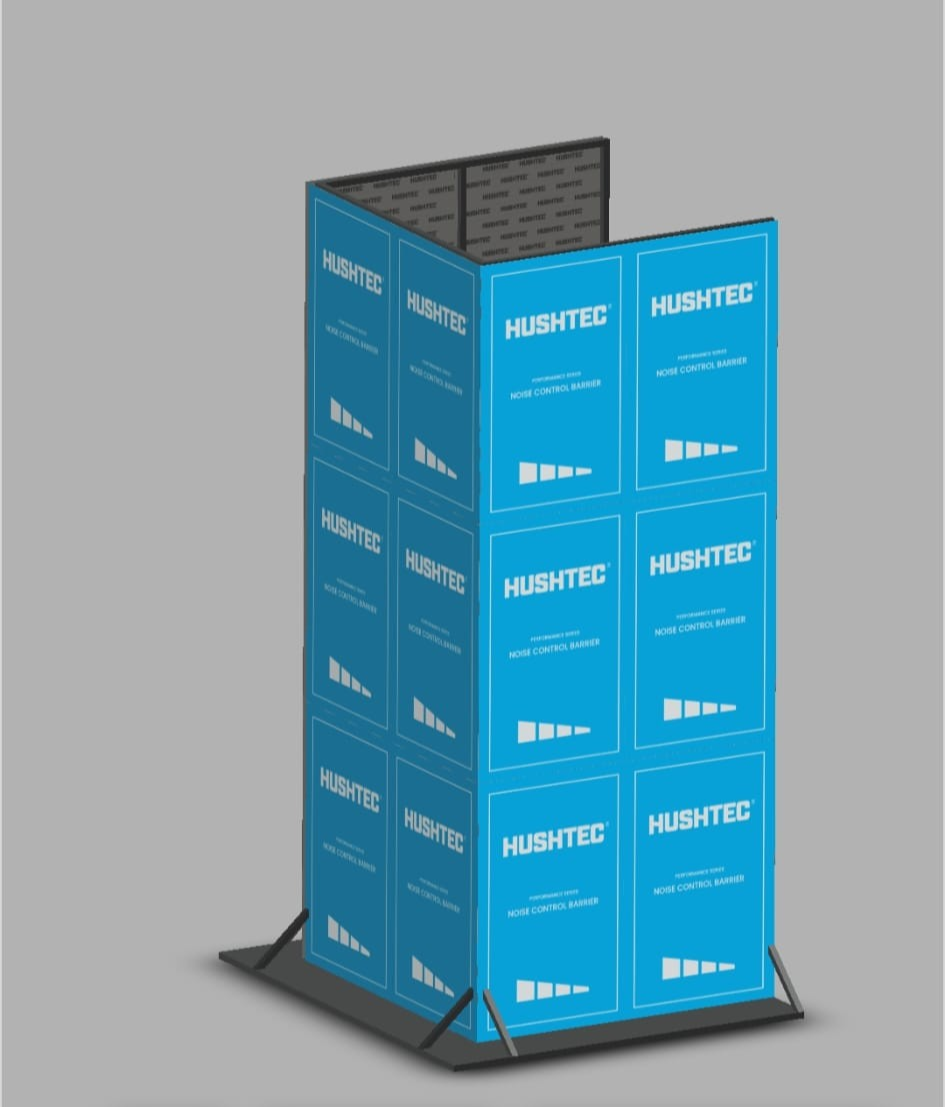
This site is supported by Hushtec, a UK manufacturer of temporary acoustic barriers made in Wakefield, West Yorkshire. Its range includes Performance, Premium and Signature Series barriers with different laboratory ratings, plus shrouds for plant such as piling rigs and breakers. Like any barrier, they help with airborne noise only when properly specified and installed, and they are one part of the answer alongside scheduling, quieter methods and good communication.
Before you act: checklist
- Are you keeping a dated log of noise and vibration, with the effect on you?
- Have you asked the contractor what hours and conditions have been agreed?
- Have you used the contractor's helpline and kept a record of the reply?
- If nothing changes, have you contacted your council's Environmental Health team?
- Is the main problem airborne noise, vibration, or both? That decides which fixes make sense.
If you are not sure where to start, our complaint guide walks you through each step, and the FAQ and Learning Centre cover the background. You can also ask for help.
This article is general guidance, not legal advice. For your specific situation, contact your council's Environmental Health team or a qualified adviser.
Frequently asked questions
Can a construction site work through the night in the UK?
Yes, in some cases. There is no single national ban on night work. Councils set or agree working hours locally, and some jobs such as tunnelling, rail work or roadworks are agreed for nights or continuous running for safety or traffic reasons. Even then, the contractor is expected to use the best practicable means to keep noise as low as it reasonably can.
Who do I complain to about construction noise at night?
Start with the contractor's site manager or community helpline, and keep a written record of what you report and the reply. If nothing changes, contact your council's Environmental Health team. The council can investigate, visit the site and use powers under the Control of Pollution Act 1974 and the Environmental Protection Act 1990 to control how the work is carried out.
What is a Section 60 notice?
A Section 60 notice is served by a council under the Control of Pollution Act 1974 to control noise from construction work. It can set permitted hours, specify which plant or machinery may be used, and set maximum noise levels. Breaching it without reasonable excuse is an offence. The contractor can appeal to a magistrates' court within 21 days of the notice being served.
Does vibration count as noise for a complaint?
Yes. Under the Environmental Protection Act 1990, section 79, noise includes vibration for statutory nuisance purposes. So if you feel shaking or a rumble through the floor from drilling or tunnelling, include it in your log and your complaint. Note that acoustic barriers only deal with airborne sound, so vibration usually needs changes to methods or plant instead.
Do acoustic barriers stop construction noise?
They reduce airborne noise when properly specified, but they do not stop it. A barrier needs enough height to block the line of sight, no gaps, a position close to the source and enough length to cover the ends. Laboratory ratings such as Rw are higher than the real reduction on site, because sound travels over the top and around the ends.
Sources
- Nation.Cymru: Residents complain of constant noise and vibrations from 24/7 Dŵr Cymru drilling works
- Control of Pollution Act 1974, section 60 (legislation.gov.uk)
- Control of Pollution Act 1974, section 61 (legislation.gov.uk)
- Environmental Protection Act 1990, section 79 (legislation.gov.uk)
- Environmental Protection Act 1990, section 80 (legislation.gov.uk)
- Welsh Statutory Instrument 2017 No. 81, article 2: approved codes of practice (BS 5228)
- North Yorkshire Council: Noise from construction and demolition sites