How can piling noise be reduced? Perimeter barriers vs piling shrouds compared
Quick answer
Airborne noise from driven piling can be cut in three main ways: a tall barrier around the site perimeter, a freestanding acoustic enclosure around the pile being driven, or a shroud fitted around the hammer itself. Measured results show a rig-mounted shroud taking around 7 dB off at 5 metres, while a freestanding enclosure can achieve 15–21 dB, but it has to be moved from pile to pile.
Key takeaways
- Driven piling is one of the loudest site activities: around 100 dB at 5 metres from an unshrouded rig in the Woodhall Spa comparison.
- A rig-mounted hammer shroud cut levels by about 7 dB at 5, 10 and 15 metres in field trials, and it travels with the rig.
- A freestanding enclosure around the active pile gives the biggest local reduction (15–21 dB), but takes a few hours to relocate between piles.
- A perimeter barrier stays put at the site boundary; how much it helps depends on its height, its distance from the rig and from your home.
- You can ask the contractor which of these they are using, and what their Section 61 consent or noise management plan commits them to.
If there's a piling rig next door, you'll know it. Every blow of the hammer is a sharp, heavy thud, and on a busy day that can mean thousands of them. In a field comparison at Woodhall Spa, an unshrouded driven piling rig measured 100 dB at 5 metres and still 89.9 dB at 15 metres.
When that's happening outside your window all day, it's hard to work, hard to rest and hard to think about much else. And it's natural to wonder whether anyone is actually trying to make it quieter.
The good news is that there are proven ways to reduce piling noise, and you're entitled to ask what's being used.
In this article you'll learn:
- the three main ways contractors can cut airborne noise from driven piling
- how much each one actually reduces noise, based on measured results
- the trade-offs that decide which option a site chooses
- what to ask the contractor or your council
Why is driven piling so loud?
Driven piling means forcing a pre-formed pile (concrete or steel) into the ground with repeated hammer blows. Each blow produces a short, high-energy impulse with a lot of low-frequency content, which travels a long way and passes easily through windows.
Not all piling is like this. Bored methods such as CFA drill the ground out rather than hammering, and are much quieter. Our guide to piling methods explains the difference. This article is about the loud kind: impact-driven piles.
Under BS 5228-1:2009+A1:2014, the British Standard code of practice for construction noise, contractors are expected to use the best practicable means (BPM) to keep noise down. In plain English, that means doing what is reasonably practicable to reduce noise, given the cost and the technical options available. For driven piling, screening and shrouding are the main practical options.
What are the options for reducing piling noise?
There are three, and they work in different places: at the site boundary, around the pile, or on the hammer itself.
| Option | Where it works | Measured or stated reduction | When the rig moves |
|---|---|---|---|
| Perimeter barrier (e.g. RapidWall) | Site boundary | Depends on height and geometry; panels rated Rw 32 dB, αw 1.0 | Stays at the boundary |
| Freestanding shroud (local enclosure) | Around the active pile | 15–21 dB | A few hours to relocate to the next pile |
| Rig-mounted shroud | Around the hammer | 7.2 dB at 5 m (field comparison) | Travels with the rig |
Figures are from Hushtec's piling noise control data. Acoustic results vary with the rig, pile type, ground and measurement conditions.
Option 1: a perimeter acoustic barrier
A tall acoustic wall along the site boundary, between the works and the nearest homes. Hushtec's RapidWall is one example: a modular, freestanding wall that can be built up to 8 metres high, using panels rated Rw 32 dB with αw 1.0 sound absorption.
Rw (weighted sound reduction index) is a lab measure of how much sound passes through a barrier material. αw (weighted sound absorption coefficient, 0 to 1) shows how much sound the face absorbs rather than reflects. An αw of 1.0 means the face absorbs almost all of it, so noise isn't bounced back across the site or towards homes opposite.
Commonly used for:
- long piling programmes where the rig moves all over the site
- sites with homes close to one boundary
- projects that also need screening for other noisy work, not just piling
Pros:
- stays in place while the rig moves, so there's no downtime
- screens other plant (breakers, generators, excavators) as well
- needs no excavation or ground anchors
Cons:
- the real-world reduction is lower than the lab Rw figure, because sound bends over the top and around the ends
- a piling rig's hammer is often high up, so the barrier needs to be tall enough to block the line of sight from the hammer to your windows
- homes on upper floors may see over it
It depends, mainly, on geometry. A barrier works best when it's close to either the noise or the listener, and tall enough to hide the source. That's why RapidWall height is designed site by site.
Option 2: a freestanding shroud around the pile
A separate acoustic enclosure that surrounds the pile position being driven, open enough for the rig to work. Hushtec states a 15–21 dB reduction for its freestanding shroud, the strongest of the three options.
Commonly used for:
- the piles closest to homes, schools or care homes
- short piling phases with a limited number of piles
- night or early-morning work where a large reduction is essential
Pros:
- the biggest local reduction of the three options
- encloses the noise at source rather than relying on a boundary wall
Cons:
- slower: allow a few hours to move it to the next pile
- that downtime can add cost and lengthen the programme, so contractors may use it selectively
Option 3: a rig-mounted shroud around the hammer
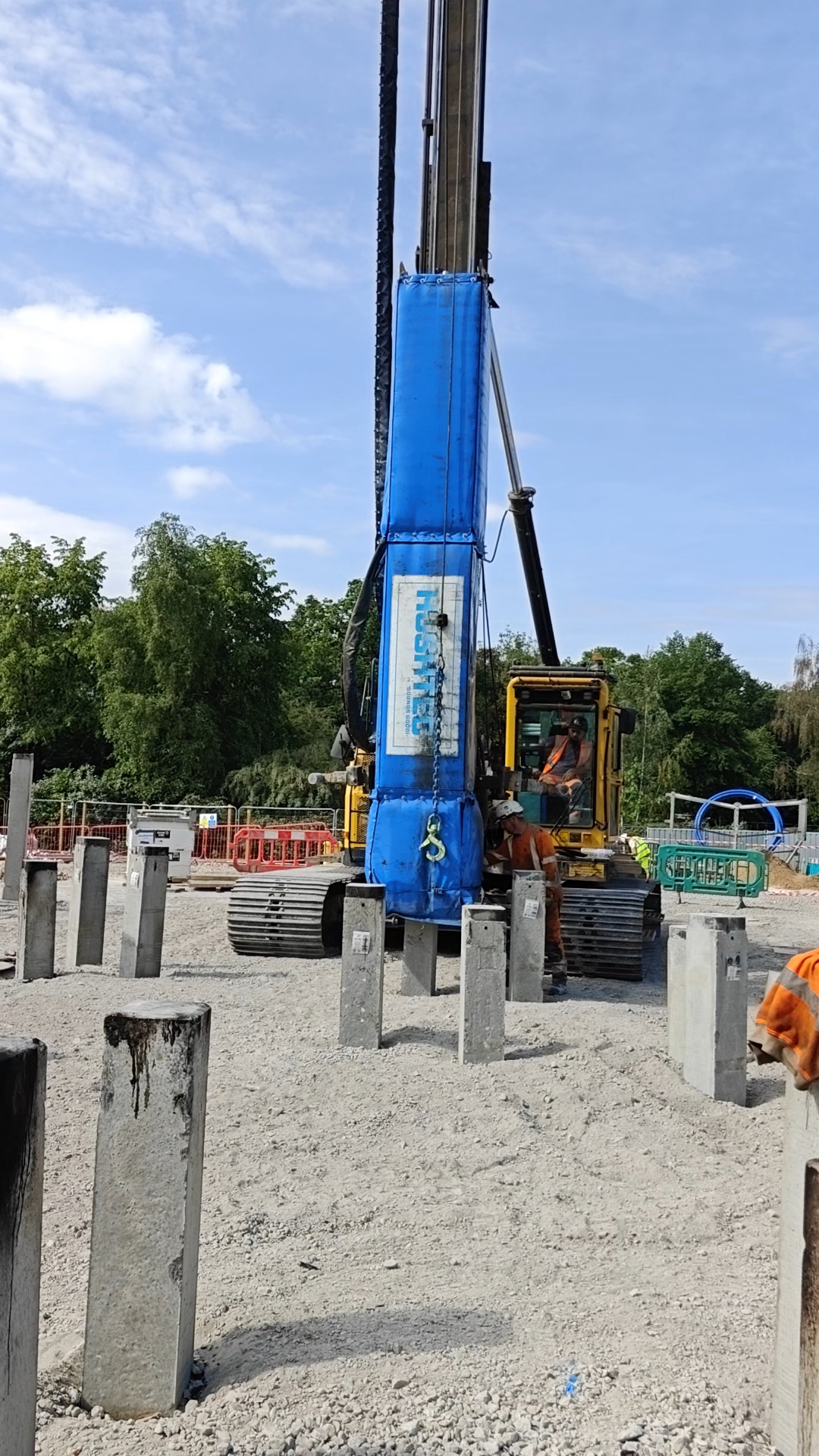
An acoustic shroud wrapped around the hammer and leader, which travels with the rig from pile to pile. Hushtec's version is made for compatible Junttan piling rigs, and fit has to be checked against the specific rig and hammer setup.
Sounds simple enough, right? The measured results show what it can do. In a field comparison, a full shroud reduced levels by about 7 dB at every distance measured:
| Distance from rig | No shroud | Half shroud | Full shroud |
|---|---|---|---|
| 5 m | 100.0 dB | 93.2 dB | 92.8 dB |
| 10 m | 94.7 dB | 88.3 dB | 88.2 dB |
| 15 m | 89.9 dB | 86.7 dB | 82.5 dB |
Full shroud measured at Woodhall Spa; half shroud measured at Ramsey; the no-shroud figures are a published baseline. These come from separate trials, so treat them as indicative.
Commonly used for:
- programmes with frequent rig moves and lots of piles
- sites where stopping to relocate an enclosure isn't practical
Pros:
- no downtime between piles: the shroud moves with the rig
- reduces noise in every direction, not just towards one boundary
Cons:
- a smaller reduction than a freestanding enclosure (around 7 dB)
- only fits compatible rigs, and is made to suit the rig, so it isn't usually available to hire
A 7 dB drop may not sound like much, but decibels are logarithmic. A 10 dB reduction is generally heard as roughly half as loud, so 7 dB is a clear, noticeable difference.
Can the options be combined?
Yes, and on sensitive sites that's often the best answer. A rig-mounted shroud cuts noise at source all the time; a perimeter barrier adds screening on the side facing homes; a freestanding enclosure can be brought in for the handful of piles closest to the nearest houses. The right mix depends on the piling programme, the number of rig moves and where the sensitive buildings are.
What else affects how much piling noise you hear?
- Piling method: bored or CFA piling is far quieter than driven piling. Ask whether a quieter method was considered.
- Distance: in the table above, moving from 5 m to 15 m dropped the unshrouded level by about 10 dB.
- Working hours: a Section 61 consent or planning condition may limit when driven piling can happen.
- Gaps and height: a barrier with gaps at the base or between panels, or one that's too low, loses much of its benefit.
What can you ask the contractor or council?
Under the Control of Pollution Act 1974, section 61, contractors can apply to the council for prior consent setting out their methods, hours and noise controls. If you're affected by piling, you can reasonably ask:
- What piling method is being used, and was a quieter method considered?
- Is the hammer shrouded, or is the active pile enclosed?
- Is there a perimeter barrier on the side facing your home, and how tall is it?
- Does the site have Section 61 consent or a noise management plan, and what does it commit to?
If you get no clear answer and the noise is affecting you, contact your council's Environmental Health team. Our complaint guide walks you through it, and the noise log helps you record dates, times and levels.
About Hushtec's piling products
The three options described above, RapidWall, the freestanding shroud and the rig-mounted shroud, are made by Hushtec. Other manufacturers make acoustic barriers and enclosures too, and the same principles apply whoever supplies them: height, no gaps, close to the source, and an absorptive face towards the works.
This site is supported by Hushtec, a UK manufacturer of temporary acoustic barriers made in Wakefield, West Yorkshire.
Before you act: checklist
- Identify whether the piling is driven (repeated thuds) or bored (continuous drone).
- Look for a shroud around the hammer or an enclosure around the pile.
- Check whether any boundary barrier is tall enough to hide the hammer from your windows, with no gaps.
- Ask the contractor about Section 61 consent and permitted hours.
- Keep a dated log of piling noise using our noise log.
- If nothing changes, contact Environmental Health — see Get Assistance.
This article is general guidance, not legal or engineering advice. For your specific situation, contact your council's Environmental Health team or a qualified acoustic consultant.
Frequently asked questions
How loud is driven piling?
In a field comparison at Woodhall Spa, an unshrouded driven piling rig measured 100 dB at 5 metres, 94.7 dB at 10 metres and 89.9 dB at 15 metres. Levels at your home depend on distance, the piling method, the rig and anything screening the noise. Bored and CFA piling are much quieter than driven piling.
How much does a piling shroud reduce noise?
A rig-mounted shroud around the hammer reduced levels by about 7 dB in field trials: 7.2 dB at 5 metres, 6.5 dB at 10 metres and 7.4 dB at 15 metres. A 10 dB reduction is generally heard as about half as loud, so 7 dB is a clearly noticeable improvement, and the shroud keeps working as the rig moves.
What is the most effective way to reduce piling noise?
Of the three common options, a freestanding enclosure around the active pile gives the largest local reduction, stated at 15–21 dB. The trade-off is time: it takes a few hours to relocate between piles. Many sites combine a rig-mounted shroud, a perimeter barrier and an enclosure for the piles nearest homes.
Will a site boundary barrier stop piling noise?
It can help, but only if it's tall enough to block the line of sight between the hammer and your windows, has no gaps, and is placed close to the works or to the homes it protects. Real-world reductions are lower than a panel's lab Rw rating because sound bends over the top and around the ends.
Can I ask a contractor what piling noise controls they are using?
Yes. You can ask which piling method is being used, whether the hammer is shrouded or the pile enclosed, whether there is a boundary barrier, and whether the site has Section 61 consent under the Control of Pollution Act 1974. If you get no clear answer, contact your council's Environmental Health team.