How high does an acoustic wall need to be to screen generator and plant noise?
Key takeaways
- Rule of thumb: wall height = height of the noise source + 1.5 m. A 2.5 m generator needs a 4 m wall.
- A standard 2 m fence-mounted barrier does not hide a 2.5 m generator, so much of the noise passes straight over it.
- BS 5228 prediction practice allows about 5 dB when the top of the plant is just visible over a barrier and about 10 dB when it is fully hidden.
- Upper-floor windows that look down on the plant need a taller wall, or a different fix such as an enclosure or a quieter power source.
- Options at 4 m and above include freestanding wall systems, scaffold-mounted barriers and stacked containers.
A generator that runs all day, or all night, is one of the most wearing noises a site can make. It does not stop for breaks, and a low drone carries a long way. If you live next to it, you may have been told “there is a barrier up” and still hear it clearly. If you run the site, you may have put up 2 m fence panels and still be getting complaints.
In both cases the likely cause is the same: the barrier is too low. This guide gives you a simple way to check the height, explains why it works, and is honest about where it does not.
How high should an acoustic wall be?
As a rule of thumb, an acoustic wall should be about 1.5 m higher than the top of the noise source.
| Height of the noise source | Wall height to aim for |
|---|---|
| 1.0 m | 2.5 m |
| 2.5 m (for example, a large site generator) | 4 m |
| 3.5 m | 5 m |
| 4.5 m | 6 m |
| 6.5 m | 8 m |
This is a working rule used at Hushtec for first estimates. It is not a substitute for a noise assessment, but it tells you quickly whether a proposed barrier is in the right range.
Why does the wall need to be taller than the generator?
A barrier works by blocking the straight path between the noise and your ears. Sound then has to bend over the top, and it loses energy doing so. The further it has to bend, the quieter it gets.
Two published references show the pattern:
- Under the BS 5228 method used to predict UK construction noise, a barrier is commonly credited with about 5 dB when the top of the plant is just visible over it, and about 10 dB when the plant cannot be seen at all.
- US Federal Highway Administration guidance gives about 5 dB once a barrier breaks the line of sight, and roughly 1.5 dB more for each extra metre of height.
A 10 dB drop sounds roughly half as loud. A 5 dB drop is noticeable but modest. So a wall level with the top of the generator gives you the smaller figure, and the extra 1.5 m is what moves you towards the larger one.
Why does a 2 m barrier not work for a generator?
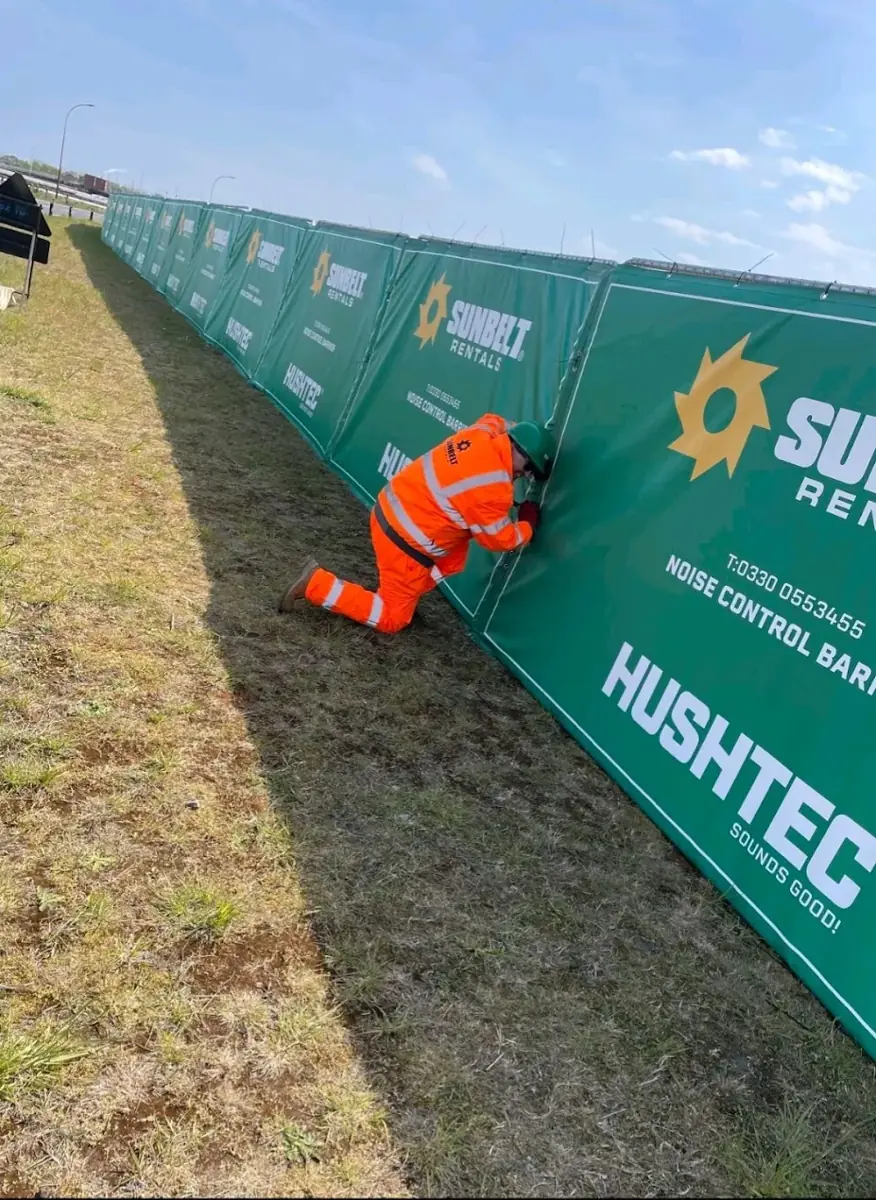
Most temporary acoustic barriers are panels hung on standard site fencing, about 2 m high. That suits low sources such as hand tools, small pumps and compact plant.
A 2.5 m generator stands above a 2 m barrier. From a ground-floor window you can often still see the top of it, and from a first-floor window you can see most of it. The panels may be good quality, but the noise is going over them, not through them.
Where does the 1.5 m rule stop working?
- Homes that overlook the site. If your bedroom window looks down on the generator, a 4 m wall may not hide it. The wall has to be high enough to block the view from the highest affected window.
- Barrier a long way from the source. A wall works best close to the plant or close to the listener. In the middle, it needs to be taller.
- Low-frequency hum. Deep engine tones bend over barriers more easily than higher-pitched noise, so the reduction you hear can be less than the headline figure.
- Gaps and short runs. Noise also goes round the ends and through gaps. A tall wall that is too short, or has openings, underperforms.
- Airflow. Generators need cooling air and a clear exhaust path. A wall should not box the set in without the supplier’s agreement.
What else reduces generator and plant noise?
A wall is not always the best first step. Ask the site whether it has looked at:
- Moving the generator further from homes, or behind a building or site cabin
- A quieter, acoustically enclosed set, or a smaller set matched to the real load
- Battery or hybrid power units, which can let the engine switch off at night
- A mains connection in place of a generator
What are the options for a temporary acoustic wall 4 m or higher?
Freestanding acoustic wall systems. Purpose-built frames carrying acoustic panels.
- Commonly used for: generators, plant compounds, demolition, data centre and battery storage (BESS) sites, and work near protected habitats
- Pros: reach 4 m to 8 m; some need no excavation or ground anchors; can be moved
- Cons: cost more than fence panels; need level ground, delivery access and a wind assessment
Scaffold-mounted barriers. Acoustic panels fixed to a scaffold structure.
- Pros: height is flexible; scaffolders are easy to find
- Cons: the scaffold must be designed for wind load on a solid face; slower to build and move
Stacked shipping containers.
- Pros: heavy and robust; can double as storage
- Cons: need a large footprint, cranage and firm ground; hard, reflective faces can bounce noise back unless lined
Where Hushtec fits. Hushtec, a New Zealand acoustic barrier manufacturer with a UK manufacturing site in Wakefield, West Yorkshire (where its Performance and Premium panels are made), makes a freestanding system called RapidWall. Its brochure lists standard heights of 2 m, 4 m, 6 m and 8 m, no ground anchors or footings, wind certification to 31 m/s and a sound insulation rating of 32 dB. Other heights are made to order. It is one option among those above, and it will not suit every site.
Disclosure: this site is funded by Hushtec Ltd and the author works for Hushtec.
What should you ask the site or the council?
- How tall is the generator or plant, and how tall is the barrier around it?
- Can the plant be seen over the barrier from the nearest homes, including upstairs windows?
- Has a BS 5228 noise assessment been done, and what reduction does it assume for the barrier?
- Can the generator be moved, swapped for a quieter set, or switched off at night?
- Are there gaps in the barrier, and does it extend well past both sides of the plant?
This guide is general information, not acoustic or legal advice. Barrier heights for a specific site should be confirmed by a qualified acoustic consultant.
Frequently asked questions
How high should an acoustic barrier be around a generator?
As a rule of thumb, about 1.5 m higher than the top of the generator. A generator 2.5 m tall needs an acoustic wall about 4 m high. If nearby windows overlook the generator, the wall may need to be taller.
Will a 2 m acoustic barrier reduce generator noise?
Only for small, low generators. If the generator is taller than the barrier, or can be seen over it from nearby homes, much of the noise passes over the top and the reduction is small.
How much noise reduction does a 4 m acoustic wall give?
It depends on the layout. Under the BS 5228 prediction method, a barrier is commonly credited with about 5 dB when the plant is just visible over it and about 10 dB when the plant is completely hidden from the listener.
Can you get a temporary acoustic wall 4 m high without foundations?
Yes. Freestanding acoustic wall systems are available in heights from 4 m to 8 m, and some need no excavation, footings or ground anchors. Scaffold-mounted barriers and stacked containers are alternatives.
Does a barrier work against low-frequency generator hum?
Less well than against higher-pitched noise. Low-frequency sound bends over barriers more easily, so a quieter generator, a battery or hybrid unit, or moving the set further away can be more effective.
Sources
Supported by Hushtec, a New Zealand manufacturer of temporary acoustic barriers with a UK manufacturing site in Wakefield, West Yorkshire, where its Performance and Premium panels are made. How this site is funded.
Related reading
Can a noisy machine on a building site be made quieter, and what can you ask for?
Often, yes. Contractors can fit shrouds or enclosures to the noisiest machines, put acoustic barriers around the work area and boundary, and plan noisy work for less sensitive hours.…
Read →What is the Rw dB rating on an acoustic barrier, and why does it matter?
Rw (weighted sound reduction index) is a single number in decibels that shows how well a material stops sound passing through it, measured in a laboratory to ISO 10140-2 and calculated…
Read →How to Record Construction Noise Evidence Your Council Will Accept
Councils act on patterns, not single events. A log that records the date, time, duration, noise type and an indicative level for several weeks is usually enough for an Environmental…
Read →