Can a noisy machine on a building site be made quieter, and what can you ask for?
Key takeaways
- A few machines, such as rock breakers, piling hammers, crushers and generators, usually cause most of the noise on a site.
- Layered noise control tackles noise at the machine, around the work zone and at the site boundary.
- A lab Rw rating is not the same as the reduction you get at your window, because sound travels over and around barriers.
- Under section 60 of the Control of Pollution Act 1974, your council can set the machinery, working hours and noise levels a site must keep to.
- Ask Environmental Health whether the site has a Section 61 consent; it shows what the contractor has already agreed to do.
If a breaker, piling rig or generator has started up on the site next to you, you’ll want to know one thing: can it be made quieter? Usually, yes. Under the Control of Pollution Act 1974, section 60, your council can tell a contractor which machinery to use, what hours to work and what noise levels to keep to. Contractors are also expected to use the best practicable means to keep noise down.
Living next to that every day is hard. It cuts into your sleep and your working-from-home calls, and it can leave you feeling nobody on the site is listening.
This guide explains the practical measures a contractor can put in place, so you know what’s reasonable to ask for.
In this article you’ll learn:
- Which site machines usually cause the most noise
- What “layered” noise control is, and what each layer does
- What an equipment shroud is, and when it helps (and when it doesn’t)
- What your rights are under UK law, and who enforces them
- A checklist of specific questions to put to the contractor or your council
Which machines on a building site are usually the loudest?
On most sites the noise doesn’t come evenly from everywhere. A handful of machines usually do most of the damage. Hushtec’s own guidance for contractors lists these as the usual culprits:
- Hydraulic rock breakers (the “hammer” on the arm of an excavator)
- Vibratory piling hammers and impact pile drivers
- Crushers and screening plant
- Concrete saws, cutters and grinders
- Generators and compressors
- Trenching equipment
Many of these produce impact noise: repeated hammering or banging, often with vibration you can feel as well as hear. If that’s what you’re getting, say so when you report it.
If you can name the machine that bothers you, write it down in your noise log alongside the time and duration. “The breaker on the excavator by the north fence, 7.40am to 10.15am” gives Environmental Health and the site manager something they can act on.
What is “layered” noise control?
Layered noise control means tackling noise at more than one point between the machine and your home: at the machine itself, around the work area, and at the site boundary.
It’s a simple idea. Each layer catches some of the sound the previous one missed.
| Layer | Where it goes | What it does | Typical examples |
|---|---|---|---|
| 1. At the machine | On or around the noisy equipment | Contains noise where it’s made | Breaker shrouds, piling shrouds, hammer wraps, generator enclosures |
| 2. Around the work zone | Close to the noisy activity | Blocks and absorbs sound across the active area | Temporary acoustic barriers, acoustic curtains |
| 3. At the boundary | Site perimeter nearest homes | Protects the closest neighbours | Modular noise walls, higher perimeter barriers |
Not every site needs all three. A short job with one quiet-ish machine may only need a boundary barrier. A long demolition job next to houses may need all three.
What is an equipment shroud?
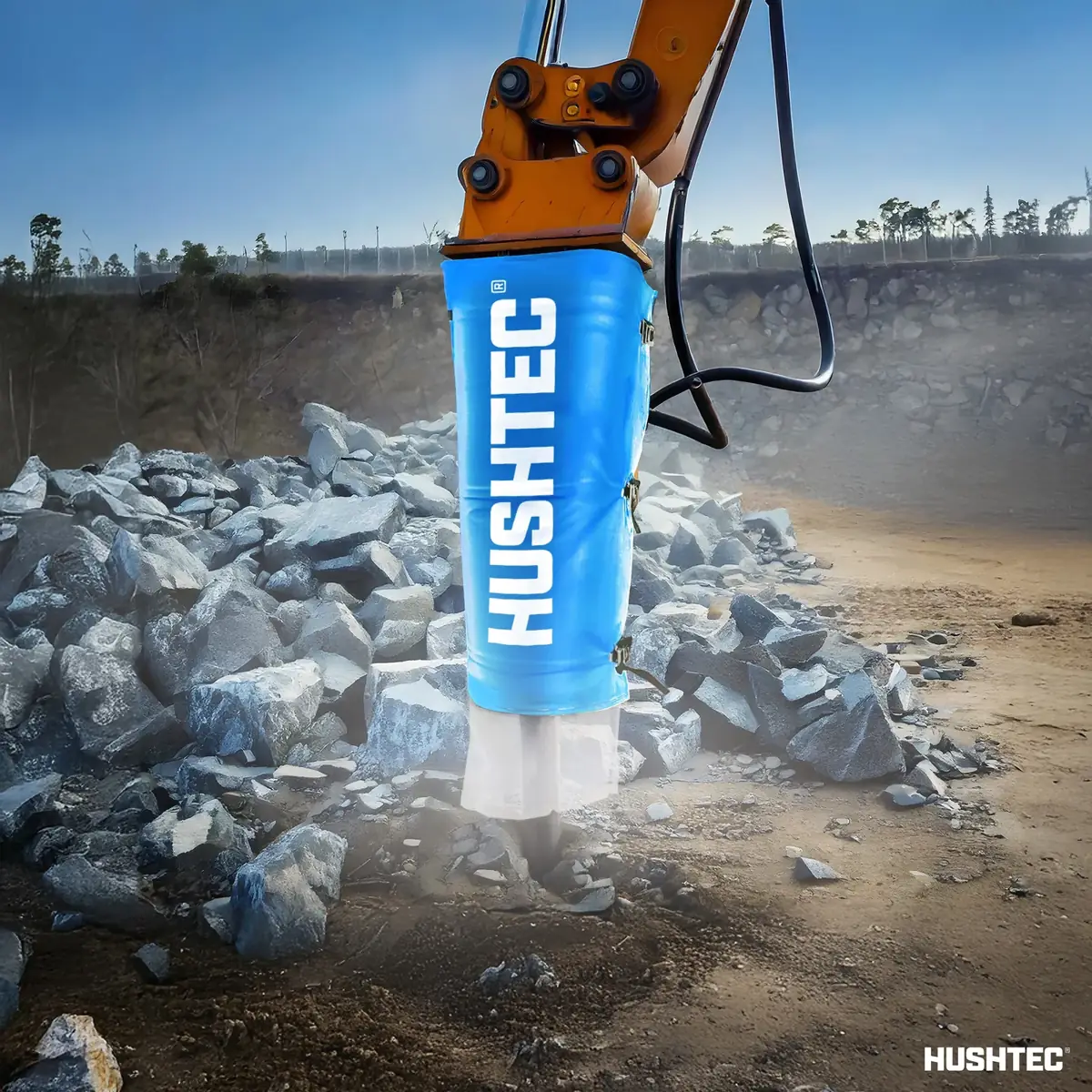
An equipment shroud is an acoustic cover or enclosure fitted around a noisy machine, or around the part of it that makes the noise, so the sound is contained before it spreads.
Commonly used for:
- Rock breakers (covering the hammer body and working point)
- Pile drivers and vibro hammers
- Crushers, saws and grinders
- Generators, compressors and pumps
Pros
- Deals with the noise at its source, so less sound bounces off nearby buildings
- Can also cut flying chips and dust from breakers
- Can reduce how tall and long the perimeter barrier needs to be
Cons
- Has to suit the specific machine; one size does not fit all
- Generators and compressors need airflow, so enclosures must be designed for cooling
- Doesn’t help with noise from other activities on site (lorries, reversing alarms, shouting)
- Results depend on fit and on the crew using it properly every time
If the noise is from piling, the options are different enough to deserve their own guide: see how piling noise can be reduced, perimeter barriers vs shrouds.
Is an acoustic barrier on its own enough?
Sometimes, but often not. A barrier around the site boundary works best when it is close to either the noise or to you, and tall enough to block the line of sight between the two.
Two terms help here:
- Rw (weighted sound reduction index) is a laboratory measure of how much sound passes through a barrier panel. A higher number means less sound gets through the material itself. (More on Rw ratings.)
- Insertion loss is the drop in noise you actually get at a particular spot once the barrier is in place. This is the figure that matters to you.
The two are not the same. On a real site, sound travels over the top of a barrier and around its ends, so the reduction at your window will be lower than the lab Rw figure. If the barrier stops short, has gaps at the bottom, or sits lower than an upstairs bedroom window, the gap between the two numbers grows.
That’s the argument for shrouding the noisiest machine as well. A barrier tries to contain noise once it has already spread; a shroud stops some of it spreading in the first place.
What are my rights if a site is too noisy?
You have more options than you might think. The main ones:
Section 60 notices. Under the Control of Pollution Act 1974, section 60, your council can serve a notice on a contractor setting out the plant or machinery that may or may not be used, the permitted working hours and the maximum noise levels. When doing so, the council must consider the approved code of practice and the use of best practicable means. Breaching a notice without reasonable excuse is an offence.
Section 61 prior consent. A Section 61 consent is an agreement a contractor can apply for in advance, setting out its working methods and the steps it will take to minimise noise. The council has 28 days to decide and can attach conditions. Knowingly breaching a condition is an offence. If a site has a Section 61 consent, ask Environmental Health for a copy: it tells you what the contractor has already promised.
BS 5228-1. BS 5228-1:2009+A1:2014 is the British Standard code of practice for noise control on construction and open sites. In England it is approved as guidance under the Control of Pollution Act 1974 (by a 2015 order made under section 71 of the Act). Councils and contractors use it to judge what good practice looks like.
Best practicable means (BPM). BPM means the contractor must do what is reasonably practicable to reduce noise, taking into account local conditions, current technical knowledge and cost. It’s defined in section 79(9) of the Environmental Protection Act 1990. This is where questions about shrouds and barriers fit: if a proven, practical measure exists and isn’t being used, it’s fair to ask why.
Statutory nuisance. Under the Environmental Protection Act 1990, section 79, noise from premises that is prejudicial to health or a nuisance can be a statutory nuisance. Your council’s Environmental Health team investigates. You can also complain directly to a magistrates’ court under section 82, after giving the person responsible at least three days’ written notice. A Section 61 consent does not, of itself, give a contractor a defence in those section 82 proceedings. Using best practicable means can be a defence where the noise comes from business activity, which is why BPM matters so much.
What can I reasonably ask the contractor for?
Start with the site manager or the community liaison contact on the hoarding. Be specific and calm. Useful questions:
| Ask about | What a good answer sounds like |
|---|---|
| Which machine is loudest | They know, and have a plan for it |
| Shrouds on breakers, piling or generators | Fitted, or a clear reason why not |
| Barrier position and height | Close to the noisy work, high enough to block line of sight to upper windows, no gaps |
| Working hours | Match the Section 61 consent or any Section 60 notice |
| Noise monitoring | They monitor and will share results or trigger levels |
| Noisiest work timing | Planned for less sensitive hours, with notice to neighbours |
If you get nowhere, go to your council’s Environmental Health team with your log.
Where does Hushtec fit in?
This site is supported by Hushtec, a New Zealand manufacturer of temporary acoustic barriers with a UK manufacturing site in Wakefield, West Yorkshire, where its Performance and Premium panels are made.
Hushtec makes equipment shrouds for rock breakers, pile drivers, vibro hammers and generators, alongside temporary acoustic barriers and enclosures. Its rock breaker shroud is listed as reducing noise by up to 10 dB and controlling dust and flying chips. As with any product, real-world results depend on the machine, the site and how the equipment is fitted and used. Other manufacturers also supply shrouds and barriers; what matters to you is that the measures are suitable and properly used.
Before you act: checklist
- Identify the specific machine or activity causing the noise
- Log the time, duration and type of noise (banging, drilling, droning)
- Ask the site whether shrouds, barriers and monitoring are in place
- Ask Environmental Health whether there is a Section 61 consent or Section 60 notice, and what it says
- Check the working hours against what has been agreed
- If the site doesn’t respond, report it to Environmental Health with your evidence
Where to next
Start a record using our guide to recording noise evidence, follow the step-by-step complaint guide, or get a rough idea of levels with the noise calculator. If you’re not sure where to begin, get assistance or browse the Learning Centre and FAQ.
This article is general guidance, not legal advice. For your specific situation, contact your council’s Environmental Health team or a qualified adviser.
Frequently asked questions
Can I ask a building contractor to put a shroud on a noisy machine?
Yes. You can ask the site manager or community liaison contact whether the loudest machines, such as rock breakers, piling hammers or generators, have shrouds or enclosures fitted. Contractors are expected to use the best practicable means to minimise noise, so if a practical measure exists and isn't being used, it's reasonable to ask why. If you get no answer, contact Environmental Health.
What is a Section 61 consent?
A Section 61 consent is prior approval a contractor can seek from the council under the Control of Pollution Act 1974. The application sets out the works, the methods and the steps proposed to minimise noise. The council has 28 days to decide and can attach conditions. Ask Environmental Health whether a nearby site has one, as it shows what the contractor has agreed to.
Is an acoustic barrier enough to stop construction noise?
Not always. A barrier's lab Rw rating describes how much sound passes through the panel, but on site sound also travels over the top and around the ends. That means the reduction at your window is usually lower than the lab figure. Barriers work best close to the noise or the listener and tall enough to block line of sight, often alongside shrouds on the loudest machines.
Who enforces construction noise rules in the UK?
Your local council, usually through its Environmental Health team. Under section 60 of the Control of Pollution Act 1974 it can set the machinery, hours and noise levels a site must keep to. It can also investigate noise as a statutory nuisance under the Environmental Protection Act 1990. You can bring your own complaint to a magistrates' court after giving three days' written notice.
What does best practicable means mean for construction noise?
Best practicable means (BPM) is the legal test for whether a contractor is doing enough to control noise. It is defined in section 79(9) of the Environmental Protection Act 1990 as what is reasonably practicable, considering local conditions, current technical knowledge and financial implications. In practice it covers choice of machinery, shrouds, barriers, working methods and timing.
Sources
- Hushtec: Construction Noise Compliance: Equipment Shrouds & Layered Noise Control (original post)
- Hushtec Rock Breaker Shroud (DirectIndustry product listing)
- Control of Pollution Act 1974, section 60
- Control of Pollution Act 1974, section 61
- Environmental Protection Act 1990, section 79
- Environmental Protection Act 1990, section 80
- Environmental Protection Act 1990, section 82
- SI 2015/227: Order approving BS 5228-1 and BS 5228-2 (England)
Supported by Hushtec, a New Zealand manufacturer of temporary acoustic barriers with a UK manufacturing site in Wakefield, West Yorkshire, where its Performance and Premium panels are made. How this site is funded.
Related reading
How high does an acoustic wall need to be to screen generator and plant noise?
As a rule of thumb, an acoustic wall should stand about 1.5 m higher than the top of the noise source. A generator 2.5 m tall therefore needs a wall about 4 m high. This guide explains…
Read →What is the Rw dB rating on an acoustic barrier, and why does it matter?
Rw (weighted sound reduction index) is a single number in decibels that shows how well a material stops sound passing through it, measured in a laboratory to ISO 10140-2 and calculated…
Read →How to Record Construction Noise Evidence Your Council Will Accept
Councils act on patterns, not single events. A log that records the date, time, duration, noise type and an indicative level for several weeks is usually enough for an Environmental…
Read →