Why Piling Noise Is Getting Louder in UK Cities — and What Residents Can Do
Quick answer
Driven precast concrete and steel piling remain the single loudest routine construction activity in UK cities, with unmitigated levels of 95–105 dB at source. Rising basement and high-rise work means more of it is happening close to homes — but the same methods that cause the problem also have recognised noise controls that residents can insist on.
Key takeaways
- Driven piling typically produces 95–105 dB at 10 metres, roughly 20 dB more than rotary bored piling on the same site.
- BS 5228-1 gives benchmark levels for piling plant and expects mitigation before noise reaches neighbouring homes.
- Asking the site for the piling method and mitigation plan is the fastest way to test whether the noise is reasonable.
- A dated log of levels and duration turns a general complaint into evidence an Environmental Health Officer can act on.
Piling is rarely the loudest thing you will ever hear on a construction site by accident. It is loud because of the physics of the method chosen: a multi-tonne hammer striking a pile, dozens of times a minute, transmits a shockwave into both the air and the ground.
Why there is more of it
Three pressures are pushing driven piling into residential areas:
- Basements and deeper foundations. Light wells, car parks and basement extensions all need retaining walls, which usually means driven sheet piles.
- Tighter urban sites. Where there is no room for a large rotary rig, a smaller driven rig often fits.
- Programme pressure. Driven piling is fast. A site can install in days what a bored rig takes weeks to complete.
How loud it actually is
Unmitigated source levels for the main driven methods sit in a narrow, very loud band:
| Method | Typical source level at 10 m | Character |
|---|---|---|
| Rotary bored / CFA | 75–85 dB | Continuous mechanical drone |
| Vibratory hammer | 80–95 dB | High-frequency buzz |
| Driven precast concrete pile | 95–105 dB | Sharp repeated impacts |
| Driven steel sheet pile | 95–105 dB | Metallic impacts plus ringing |
Because decibels are logarithmic, the gap between 80 dB and 100 dB is not "25% louder" — it is a hundred-fold increase in sound energy.
What the guidance expects
BS 5228-1 is the Code of practice for noise and vibration control on construction and open sites, and it is the document Environmental Health Officers reach for. It does not ban loud methods. It expects them to be controlled.
In practice that means:
- Selecting a quieter method where reasonably practicable (rotary bored or CFA instead of driven piles).
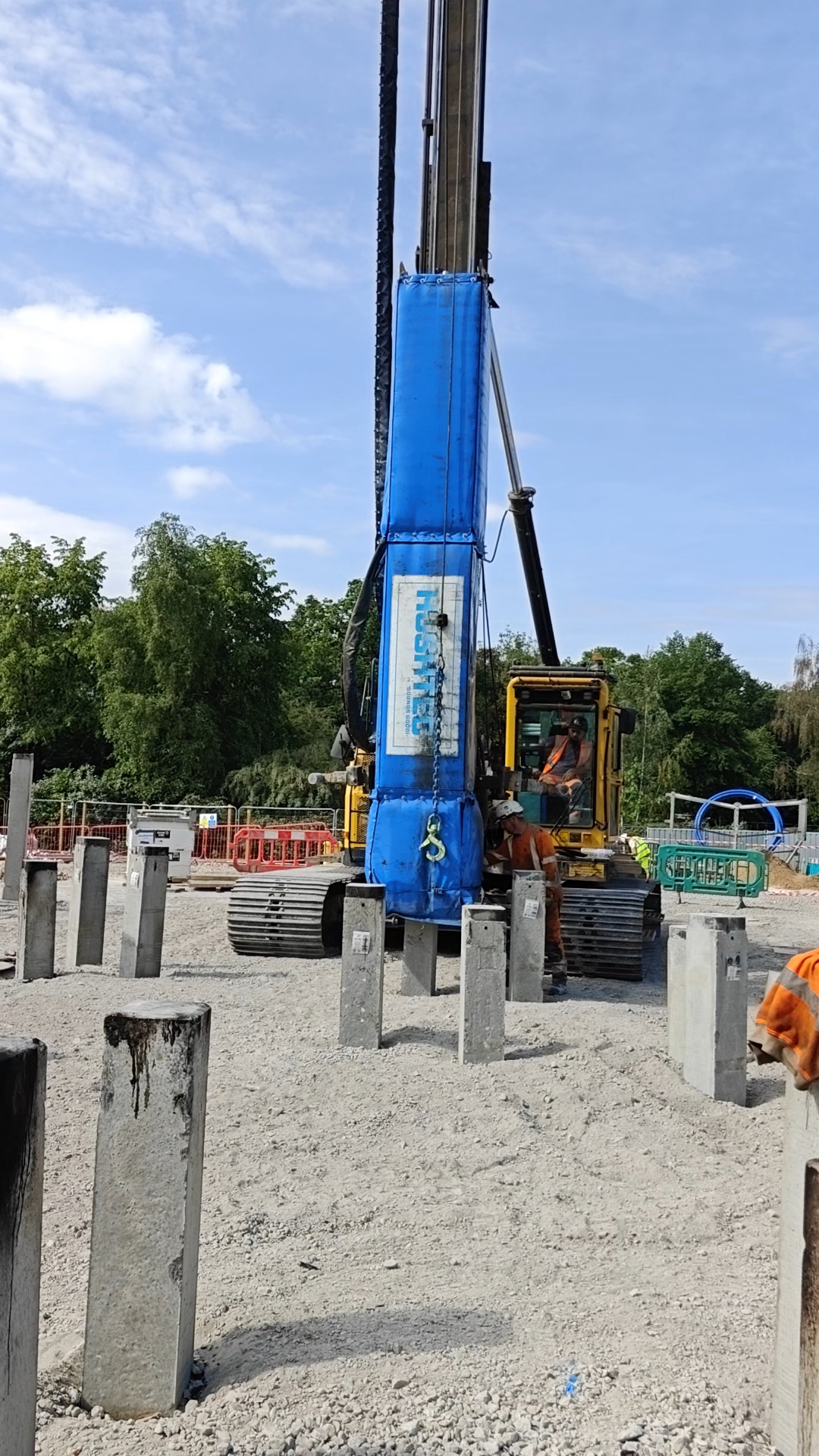
- Using acoustic shrouds or screens around impact hammers.
- Positioning plant as far from dwellings as the site allows.
- Informing neighbours in advance, with dates and predicted duration.
- Restricting hours so that no piling happens outside permitted times.
How much can shrouds and screens actually help?
There are three main options for driven piling, and measured results show what each can achieve:
| Option | Reduction | When the rig moves |
|---|---|---|
| Rig-mounted shroud around the hammer | About 7 dB (7.2 dB at 5 m) | Travels with the rig |
| Freestanding enclosure around the active pile | 15–21 dB | A few hours to relocate |
| Perimeter acoustic barrier (up to 8 m high) | Depends on height and position | Stays at the boundary |
In a field comparison, an unshrouded rig measured 100.0 dB at 5 metres; with a full shroud fitted, 92.8 dB. At 15 metres the figures were 89.9 dB and 82.5 dB. These are indicative results from separate trials, using product data from Hushtec, which supports this site. Our full guide, How can piling noise be reduced? Perimeter barriers vs piling shrouds compared, explains the trade-offs.
What you can do this week
Ask three questions. Which piling method is being used, what mitigation is in place, and what hours will the work run? A site that cannot answer is worth reporting.
Log it properly. Record the date, start and end time, and an indicative level from a smartphone meter. A month of consistent entries is far more persuasive than a single angry email.
Report to Environmental Health. Your council has a duty to investigate complaints of statutory nuisance under the Environmental Protection Act 1990. Provide your log, not just a description.
If you want to understand the difference between the piling types you are hearing, the Learning Centre has a full breakdown of every piling method and its noise profile.
Frequently asked questions
Is piling noise allowed at weekends?
Usually not. Most councils set permitted construction hours of around 08:00 to 18:00 on weekdays, 08:00 to 13:00 on Saturdays, and no working on Sundays or bank holidays. Piling outside those hours is normally a breach that Environmental Health can act on immediately.
How far away can driven piling be heard?
A driven pile at 100 dB at 10 metres is still around 70 dB at 100 metres in open conditions, which is comparable to a busy road. In streets with reflective facades, levels fall more slowly, so piling several hundred metres away can still be clearly audible indoors.
Can I complain about a site that has planning permission?
Yes. Planning permission governs what can be built, not how much noise it makes during construction. Noise from the works is controlled separately under the Environmental Protection Act 1990 and by the site's planning conditions.