Acoustic barriers up to 2 metres high
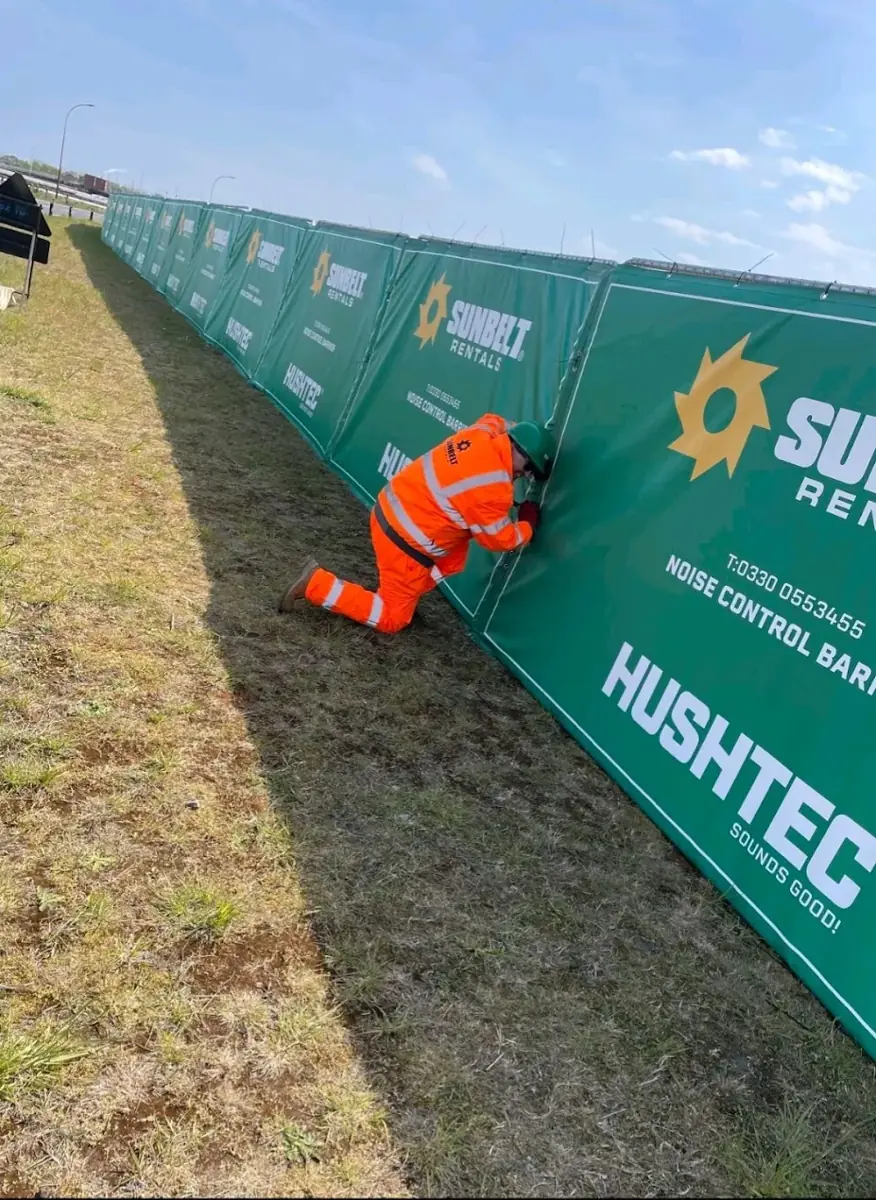
What is a 2 metre acoustic barrier?
A temporary acoustic barrier is a flexible, heavy panel with a sound-absorbing face, fixed to something that already stands up: usually temporary site fencing, timber hoarding or scaffold. Panels join edge to edge to make a continuous noise screen as long as the site needs.
Two metres is the natural height for this kind of barrier, because that’s the height of standard temporary fence panels. It’s the most common form of construction noise screening in the UK, and on many sites it’s all that’s needed.
Commonly used for:
- Site perimeters next to houses, schools and offices
- Ground-level plant: generators, compressors, pumps, cutting stations, mixers
- Roadworks and utility works, where the barrier moves with the job
- Screening a work area within a larger site
How much difference does it make?
A barrier works by blocking the direct path between the noise and the listener, so sound has to bend over the top. BS 5228-1, the UK code of practice for construction noise, gives a simple rule of thumb:
| Situation | Typical reduction |
|---|---|
| Barrier completely hides the plant from the listener | About 10 dB |
| Barrier just hides the top of the plant | About 5 dB |
| Plant still visible over or round the barrier | Little or none |
A 10 dB drop sounds roughly half as loud. That’s a real improvement, but it depends entirely on the barrier breaking the line of sight.
Rw (weighted sound reduction index) is a laboratory rating, in dB, of how much sound a panel stops passing straight through it. It’s useful for comparing products, but it’s not the reduction you’ll get on site, because on site sound also goes over the top and round the ends. That’s why a well-fitted panel with a moderate Rw often beats a better panel that’s badly installed.
αw (weighted sound absorption coefficient) rates, from 0 to 1, how much sound the face soaks up rather than reflects. A highly absorbent face stops noise bouncing around the site and out over the top. A barrier rated at 0.10 or below isn’t classified for absorption at all and behaves much like solid hoarding.
What good looks like
- High enough: hides the plant from the windows that matter, not just the ground floor
- No gaps: panels overlap or seal edge to edge, and the bottom sits on the ground
- Close to the noise: a barrier near the plant protects a much wider area than one on a distant boundary
- Long enough: runs past both ends of the noisy area, so sound can’t go round
- Absorbent face towards the works
- Tested figures: an Rw to ISO 717-1 and an αw to ISO 11654 from a named test lab
- Secure fixing: panels that flap in the wind leave gaps and become a hazard
When a 2 m barrier isn’t enough
- Upstairs windows and flats. If the neighbours look down onto the works, a 2 m fence line doesn’t block anything. You need a taller wall, or to deal with the noise at the machine.
- Tall plant. Piling hammers, crushers and tall rigs sit well above 2 m. See acoustic barriers up to 8 metres high and pile rig shrouds.
- Impact noise right next to homes. Breakers and hammers are often better tackled at source with a rock breaker shroud.
- Where people need to see through it. For sightlines, light or safety, look at transparent acoustic barriers.
Pros and cons
Pros
- Quick to fit and move on existing fencing, hoarding or scaffold
- Widely available to buy or hire
- Effective for ground-level neighbours and low plant when fitted properly
- An absorbent face also helps the people working on site
Cons
- Limited to about 2 m on standard fencing
- Little benefit for upper floors or tall plant
- Performance depends heavily on installation: gaps and loose panels undo it
- Headline “up to” figures on spec sheets can mislead; compare Rw and αw instead
What to ask for
If you’re specifying or hiring barriers, or checking a site next to your home, ask:
- What is the panel’s Rw, and which lab tested it to which standard?
- What is its αw (ISO 11654)?
- Does the barrier hide the plant from the nearest and highest affected windows?
- How are joints and the base sealed?
- Was the barrier chosen as part of a BS 5228-1 noise assessment?
Hushtec’s 2 metre barriers
This site is supported by Hushtec, a New Zealand manufacturer of temporary acoustic barriers with a UK manufacturing site in Wakefield, West Yorkshire, where its Performance and Premium panels are made.
Hushtec’s fence-mounted panels come in three grades: Performance (Rw 26 dB), Premium (Rw 32 dB) and Signature Series (Rw 38 dB). Performance and Premium both have an absorbent face rated αw 1.0, Class A to ISO 11654. The standard Performance panel is 2000 × 1300 mm, with Velcro joins and eyelets so panels form a continuous wall. Two layers of Performance with an air gap between them can outperform a single layer of Premium, because the gap decouples the layers. For large runs where absorption matters less, Hushtec also makes the Mission Series, a thinner, reflective-only mass-loaded barrier in 4, 6, 8 and 10 kg/m² weights. Where people need to see through the screen, the clear Vision Series can be joined in (see transparent acoustic barriers). In the UK the panels can be hired from Sunbelt, Safesite and Securasite.
Common questions
How much noise does a 2 m acoustic barrier reduce?
As a rule of thumb from BS 5228-1, a barrier that completely hides the noisy plant from the listener reduces noise by about 10 dB, and one that only just hides the top of it by about 5 dB. If the plant can be seen over or round the barrier, the benefit is small. The panel's laboratory Rw is always higher than the reduction you get on site.
Can you stack fence-mounted panels higher than 2 m?
Not safely on standard temporary fencing. Heras-style fence panels are about 2 m tall and are not designed for the wind load of a taller acoustic face. For screens above 2 m, use a freestanding acoustic wall designed and wind-load tested for the height, or barriers fixed to a properly designed scaffold.
What Rw rating should a 2 m acoustic barrier have?
It depends on the noise and how close the neighbours are. Once a barrier is reasonably heavy, sound going over the top usually limits the result, so height and gap-free fitting matter more than a few extra decibels of Rw. For heavy plant close to homes, a higher-rated panel, two layers with an air gap, or a shroud on the machine is worth considering.
Which way round should an acoustic barrier face?
The soft, absorbent face should face the works. That side soaks up sound instead of reflecting it back across the site and out over the top. If the absorbent face is turned towards the neighbours, the barrier still blocks some sound but reflects more of it around the site.
Not sure which option fits your site?
Tell us what the noisy activity is, how close the neighbours are and how long the work runs, and we'll point you to what's likely to work.
Live near a site? See how to complain so something happens.
Related guides
Other options
Acoustic barriers up to 8 metres high
Freestanding acoustic walls for tall plant, piling, demolition and neighbours in upper-floor flats, where a 2 m fence line can't help.
Transparent acoustic barriers
See-through noise screens for when people need to see in or out: sightlines for safety, light for neighbours, visibility for shops and traffic.
Rock breaker shrouds
Acoustic covers fitted round a hydraulic breaker, so the noise is cut at the machine instead of at the site boundary.
Pile rig shrouds
Purpose-made acoustic shrouds and enclosures for driven piling. Why wrapping ordinary barrier panels round a rig does very little.
General guidance, not legal or engineering advice. Supported by Hushtec, a New Zealand manufacturer of temporary acoustic barriers with a UK manufacturing site in Wakefield, West Yorkshire, where its Performance and Premium panels are made.