Rock breaker shrouds
What is a rock breaker shroud?
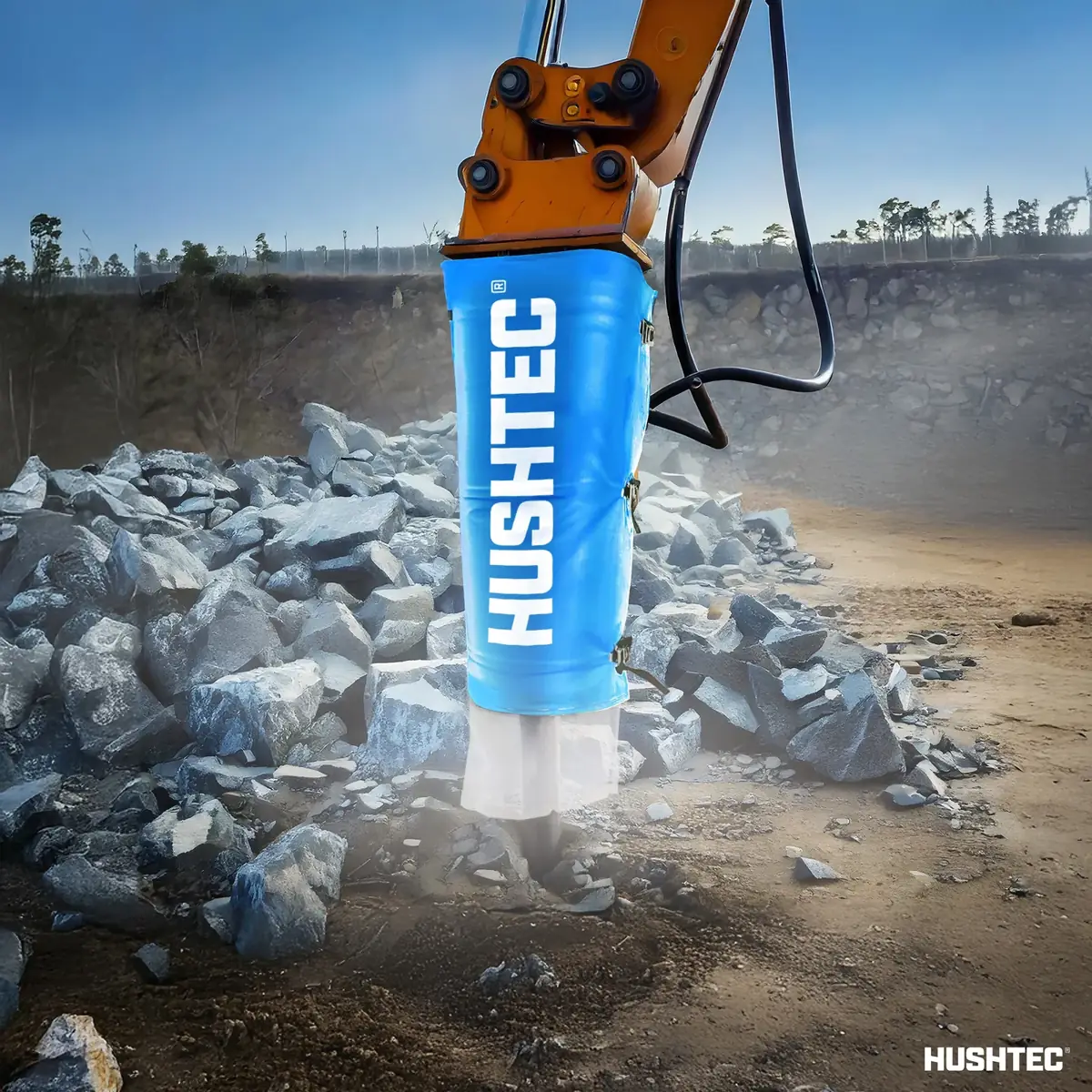
A rock breaker shroud is an acoustic cover that wraps round the body of a hydraulic breaker (also called a hydraulic hammer or pecker) fitted to an excavator. It’s made from heavy, sound-blocking material with an absorbent lining, and fits around the breaker housing while leaving the tool point free to work.
Hydraulic breakers are among the loudest tools on a site and one of the commonest causes of complaints. They’re used for demolition, breaking out concrete and rock, utility trenches and foundations.
Commonly used for:
- Demolition and breaking out slabs near homes and offices
- Rock breaking in quarries, cuttings and foundations
- Utility and roadworks in residential streets
- Night or weekend work where noise limits are tight
Why treat the noise at the machine?
A barrier protects only the area behind it. A breaker moves around the site and often works above barrier height, so a fence-line barrier soon stops helping. A shroud:
- Reduces noise in every direction, not just towards one boundary
- Moves with the machine, so there’s nothing to relocate
- Helps the operator and site team as well as the neighbours
How much difference does it make?
| Test | Without shroud | With shroud |
|---|---|---|
| Hushtec rock breaker test | 92.4 dB | 77.4 dB |
That’s a 15 dB reduction. As a guide, 10 dB sounds roughly half as loud. Results elsewhere depend on the breaker, what it’s breaking, the distance and the surroundings.
Limits
- The tip is still exposed. The tool has to strike the material, and that impact makes noise.
- No effect on vibration. Ground vibration from breaking needs to be managed by method, plant size and hours.
- Fit matters. A loose or damaged shroud leaks sound. It must suit the breaker model, leave hoses free and allow for servicing and heat.
- Very close neighbours may still need screening round the work area, or a quieter method such as crushing or cutting.
Pros and cons
Pros
- Cuts noise at source, in all directions
- Stays with the breaker as it moves
- Quick win on a site where one machine causes most complaints
- Can be combined with barriers and scheduling
Cons
- Doesn’t silence the impact at the tip
- Needs to suit the specific breaker
- Must be checked and maintained to keep working
- Does nothing for vibration
What to ask for
- Is the shroud made for this breaker model, and how is it fixed?
- What measured reduction has it achieved, and under what conditions?
- How does it allow for hoses, heat and servicing?
- Who checks it for wear and damage, and how often?
- What else is in the noise plan: hours, screening, quieter methods?
Hushtec’s breaker shrouds
This site is supported by Hushtec, a New Zealand manufacturer of temporary acoustic barriers with a UK manufacturing site in Wakefield, West Yorkshire, where its Performance and Premium panels are made.
Hushtec’s Rock Breaker Shroud is an acoustic wrap that encloses the breaker, with a universal fit system for machines up to and over 50 tonnes. Hushtec says it installs in under five minutes. A clear acoustic viewing panel round the pick keeps the tool visible to the operator and also helps contain dust and flying chips. Hushtec rates it at up to 15 dB reduction, depending on the machine model and condition, which matches the 92.4 dB to 77.4 dB result above. To check fit for a particular breaker, describe your machine and site.
Common questions
How much does a breaker shroud reduce noise?
In a Hushtec test, a rock breaker measured 92.4 dB without a shroud and 77.4 dB with one, a 15 dB reduction. A 10 dB drop sounds roughly half as loud. Results on other sites depend on the breaker, the material being broken, distance and the surroundings.
Why fit a shroud instead of a barrier?
A barrier only protects the area behind it, and a breaker on an excavator moves around the site and works above barrier height. A shroud stays on the breaker, so it reduces noise in every direction wherever the machine goes. On busy sites both are often used: the shroud at source and barriers at the boundary.
Does a breaker shroud stop all the noise?
No. The shroud covers the body of the breaker, but the tool has to stay exposed to strike the material, and the impact itself makes noise. Ground vibration is not affected. Shrouds work best combined with sensible working hours and, near homes, screening around the work area.
Will a shroud fit any breaker?
Shrouds need to suit the breaker's size and shape, leave hoses and the tool free, and allow servicing. Check the fit for the specific breaker model before ordering, and agree how it will be fitted and inspected.
Not sure which option fits your site?
Tell us what the noisy activity is, how close the neighbours are and how long the work runs, and we'll point you to what's likely to work.
Live near a site? See how to complain so something happens.
Related guides
Other options
Acoustic barriers up to 2 metres high
Acoustic panels that clip onto temporary fencing, hoarding or scaffold. The everyday answer for perimeter screening and ground-level plant.
Acoustic barriers up to 8 metres high
Freestanding acoustic walls for tall plant, piling, demolition and neighbours in upper-floor flats, where a 2 m fence line can't help.
Transparent acoustic barriers
See-through noise screens for when people need to see in or out: sightlines for safety, light for neighbours, visibility for shops and traffic.
Pile rig shrouds
Purpose-made acoustic shrouds and enclosures for driven piling. Why wrapping ordinary barrier panels round a rig does very little.
General guidance, not legal or engineering advice. Supported by Hushtec, a New Zealand manufacturer of temporary acoustic barriers with a UK manufacturing site in Wakefield, West Yorkshire, where its Performance and Premium panels are made.