Acoustic barriers up to 8 metres high
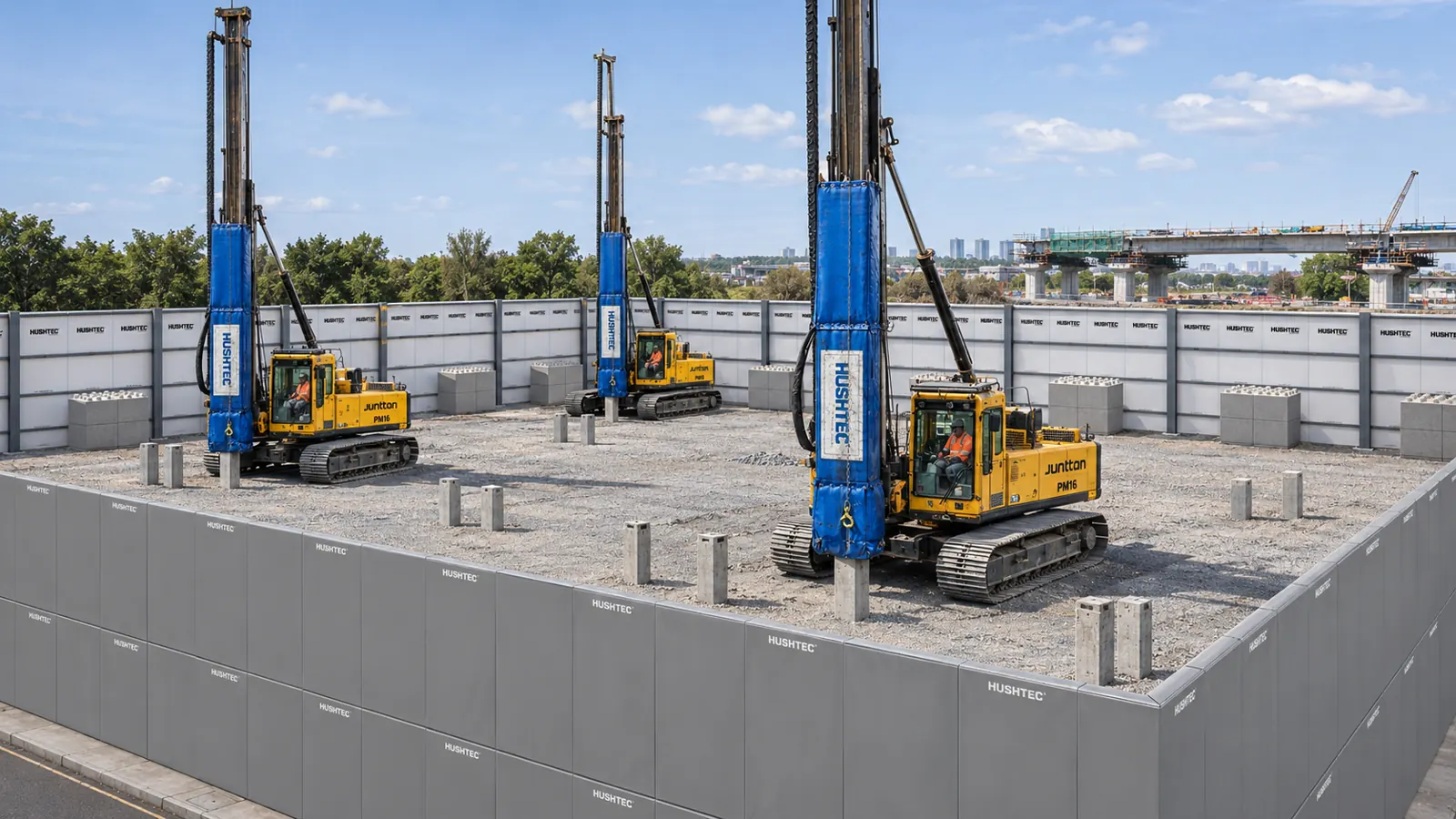
Why go taller than 2 metres?
A barrier only works if it blocks the line of sight between the noise and the listener. Standard temporary fencing stops at about 2 m, which is fine for ground-level neighbours and low plant. It does almost nothing when:
- The noise source is tall: piling hammers high on the leader, crushers, concrete pumps, cranes, large generators
- Neighbours look down on the site: flats, offices and houses with upstairs windows
- The site is in a city centre: surrounded by taller buildings, where sound reflects back and forth
In those cases you need either a taller wall or to treat the noise at the machine (see pile rig shrouds and rock breaker shrouds). Often the best answer is both.
How high does the wall need to be?
Hushtec’s working rule is that an acoustic screen should be about 1.5 m higher than the top of the noise source. So a 2.5 m generator needs a wall of about 4 m. This is a first estimate, not a standard. If windows overlook the source, the wall needs to be taller again, and a noise assessment to BS 5228-1 should confirm the height. Our guide How high does an acoustic wall need to be? works through examples.
What are the options for a tall acoustic wall?
| Option | How it works | Commonly used for | Watch out for |
|---|---|---|---|
| Freestanding acoustic wall | Modular frame and acoustic panels standing on the ground | Piling, demolition, generators, data centres, perimeters with buried services | Needs space for the base; check the wind rating for the height |
| Scaffold-mounted barriers | Acoustic panels or curtains fixed to a designed scaffold | Façade work, sites already scaffolded | Scaffold design must allow for wind on the acoustic face; ties and footings |
| Stacked container wall | Shipping or site containers stacked as a screen | Long-term perimeters, sites that need the storage | Hard, reflective faces unless lined; gaps between units; crane needed to move |
All three can work. The right one depends on height, how long it’s needed, how often it moves, the ground, and whether the faces need to absorb sound or just block it.
What good looks like
- Height set from a noise assessment, using the 1.5 m rule only as a first check
- Wind design for the actual height and location, with a stated wind rating
- No gaps between modules or at the base
- Absorbent face towards the works, so noise doesn’t bounce off the wall and back over the site
- Close to the noise, with returns or a U-shape round the noisiest area where possible
- Tested panel figures: an Rw for sound insulation and an αw for absorption
Limits
- It’s airborne noise only. A wall does nothing for ground vibration.
- Very tall sources may still be visible. A piling hammer near the top of a leader can sit above even an 8 m wall; a shroud on the hammer or an enclosure round the active pile may be needed as well.
- Space and access. Freestanding bases and container walls take up ground. Plan for access, deliveries and emergency routes.
What to ask for
- What height has the noise assessment recommended, and to which windows?
- What is the system’s wind rating at that height, and who designed it?
- Does it need anchors, footings or excavation, and are there buried services?
- What are the panel’s Rw and αw, and are the faces absorbent?
- How quickly can it be extended, moved or reconfigured as the work changes?
Hushtec’s tall-wall option: RapidWall
This site is supported by Hushtec, a New Zealand manufacturer of temporary acoustic barriers with a UK manufacturing site in Wakefield, West Yorkshire, where its Performance and Premium panels are made.
Hushtec’s RapidWall is a modular freestanding acoustic wall. It stands without ground anchors, footings or excavation, in standard heights of 2 m, 4 m, 6 m and 8 m (other heights on request), and is wind certified to 31 m/s. It uses panels with a sound insulation rating of 32 dB, and can be set out as a U-shape, an L-shape, a perimeter or a corridor. It’s one option alongside scaffold-mounted barriers and container walls, and the right choice depends on the site.
Common questions
How high should an acoustic wall be?
As a first estimate, Hushtec works on the wall being about 1.5 m higher than the top of the noise source, so a 2.5 m generator needs a wall of around 4 m. If neighbours' windows look down on the source, the wall needs to be taller again. This is a starting point, not a substitute for a noise assessment to BS 5228-1.
Can you put acoustic barriers on temporary fencing higher than 2 m?
No. Standard temporary fence panels are about 2 m tall and are not designed to carry a taller acoustic face in the wind. Above 2 m you need a system designed and wind-load tested for the height: a freestanding acoustic wall, barriers on a properly designed scaffold, or a stacked container wall.
Does a tall acoustic wall need foundations?
It depends on the system. Some freestanding acoustic walls are designed to stand on the ground without anchors, footings or excavation, which suits sites with buried services or hard standing. Scaffold-mounted screens need a scaffold design that allows for wind on the acoustic face. Always ask for the design basis and the wind rating for the height you need.
Does a tall acoustic wall stop vibration?
No. An acoustic wall only reduces airborne noise. Vibration travels through the ground under the wall and has to be dealt with by the choice of method, plant and working hours.
Not sure which option fits your site?
Tell us what the noisy activity is, how close the neighbours are and how long the work runs, and we'll point you to what's likely to work.
Live near a site? See how to complain so something happens.
Related guides
Other options
Acoustic barriers up to 2 metres high
Acoustic panels that clip onto temporary fencing, hoarding or scaffold. The everyday answer for perimeter screening and ground-level plant.
Transparent acoustic barriers
See-through noise screens for when people need to see in or out: sightlines for safety, light for neighbours, visibility for shops and traffic.
Rock breaker shrouds
Acoustic covers fitted round a hydraulic breaker, so the noise is cut at the machine instead of at the site boundary.
Pile rig shrouds
Purpose-made acoustic shrouds and enclosures for driven piling. Why wrapping ordinary barrier panels round a rig does very little.
General guidance, not legal or engineering advice. Supported by Hushtec, a New Zealand manufacturer of temporary acoustic barriers with a UK manufacturing site in Wakefield, West Yorkshire, where its Performance and Premium panels are made.