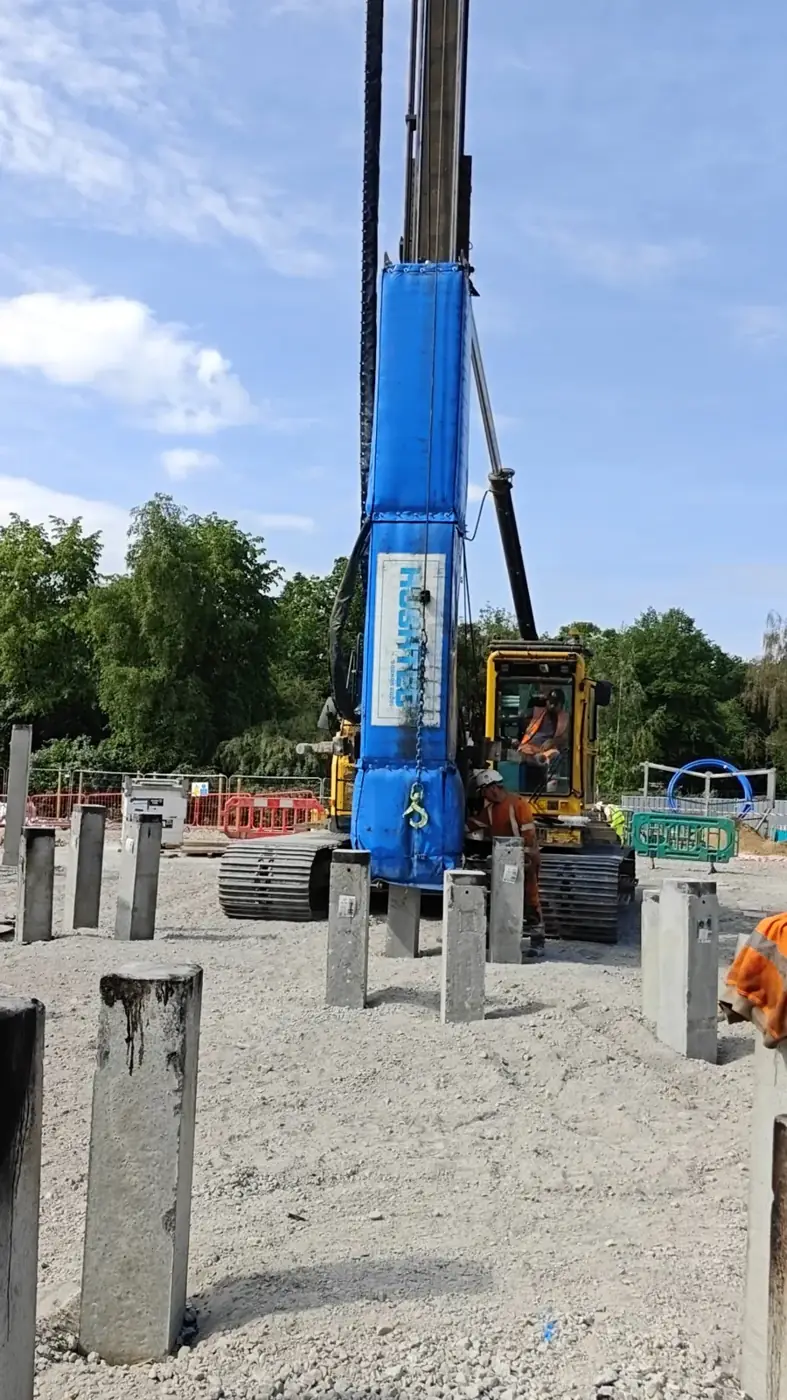
Pile rig shrouds
Why is piling so hard to screen?
Driven piling, where a hammer strikes a precast concrete or steel pile into the ground, produces sharp, repeated impacts that carry a long way. The problem for screening is height: the hammer sits high on the rig’s leader, well above a 2 m fence line, so a perimeter barrier often hides the rig’s tracks but not the noise.
There are three main ways to tackle it, and they’re often used together.
| Option | Typical reduction | When the rig moves | Best for |
|---|---|---|---|
| Rig-mounted shroud round the hammer | About 7 dB (7.2 dB at 5 m) | Travels with the rig | Sites with frequent rig moves |
| Freestanding enclosure round the active pile | 15–21 dB | A few hours to relocate | Piles nearest homes, sensitive times |
| Tall perimeter wall | Depends on height and position | Stays at the boundary | Protecting a whole frontage; see barriers up to 8 m |
How much does a rig-mounted shroud help?
A rig-mounted shroud is an acoustic cover made to fit round the pile hammer, so it moves up and down the leader with it. Field comparisons give a clear picture:
| Distance | No shroud | Half shroud | Full shroud |
|---|---|---|---|
| 5 m | 100.0 dB | 93.2 dB | 92.8 dB |
| 10 m | 94.7 dB | 88.3 dB | 88.2 dB |
| 15 m | 89.9 dB | 86.7 dB | 82.5 dB |
Indicative results from separate trials: full shroud at Woodhall Spa, half shroud at Ramsey, no-shroud figures from a published baseline. Results vary with rig, pile, ground and measurement conditions.
About 7 dB is a clearly noticeable improvement, and because the shroud stays on the hammer it keeps working as the rig moves round the site.
The common mistake: wrapping barrier panels round the rig
It’s tempting to hang standard fence-style acoustic panels round a piling rig. It does very little. The hammer is still high and exposed, the panels leave gaps everywhere, and they aren’t designed for the movement and loads around a working rig. Piling needs a shroud made for the hammer, an enclosure round the active pile, or a wall tall enough to hide the hammer.
Limits
- Results are site-specific. Rig, hammer, pile type and ground all change the numbers.
- No effect on vibration. Ground vibration from driven piling has to be managed by method (for example rotary bored or CFA piling instead of driven), plant and hours.
- Fit is specific. A rig-mounted shroud must suit the rig and hammer configuration.
- Enclosures cost time. Moving a freestanding enclosure between piles slows production, so it’s usually kept for the piles nearest homes.
Pros and cons of a rig-mounted shroud
Pros
- Treats the noise at source, in every direction
- Moves with the rig, so no relocation time
- Protects the site team as well as neighbours
- Combines well with perimeter walls and enclosures
Cons
- Smaller reduction than a full enclosure round the pile
- Must fit the specific rig and hammer
- Doesn’t help with vibration
What to ask for
- Which piling method is being used, and was a quieter method considered?
- Is the hammer shrouded, and is the shroud made for this rig?
- Will the piles nearest homes have an enclosure or extra screening?
- What does the Section 61 consent or noise management plan commit to?
- What hours will piling run, and how will neighbours be told in advance?
Hushtec’s piling options
This site is supported by Hushtec, a New Zealand manufacturer of temporary acoustic barriers with a UK manufacturing site in Wakefield, West Yorkshire, where its Performance and Premium panels are made.
Hushtec’s Pile Drive Shroud is custom-built to fit the specific hammer, rig or pile type, including compatible Junttan rigs. It combines Hushtec Premium acoustic barrier for sound absorption with a Vision 5 transparent panel, so the operator can still see the pile head, and it can be made to any height. Hushtec rates it at up to 15 dB reduction, depending on site conditions and equipment. For vibratory piling there is a matching Vibro Hammer Shroud, custom-built to encase the vibrating hammer, with cut-outs for the hydraulics.
Hushtec also makes a freestanding shroud that encloses the active pile, and the RapidWall freestanding perimeter wall up to 8 m. The field figures above come from Hushtec’s 2026 piling noise data. To check what suits your rig and site, describe your piling job.
Common questions
How much does a pile rig shroud reduce noise?
In field comparisons, a full rig-mounted shroud reduced driven piling noise from 100.0 dB to 92.8 dB at 5 m, from 94.7 to 88.2 dB at 10 m, and from 89.9 to 82.5 dB at 15 m: roughly 7 dB. These are indicative results from separate trials, and results vary with the rig, pile, ground and measurement conditions.
Can you just wrap acoustic barriers round a piling rig?
Not effectively. Fence-style panels hung round a rig leave the hammer, which sits high on the leader, in full view, with gaps everywhere. The result is close to nothing. Piling needs a shroud made to fit the hammer, an enclosure round the active pile, or a wall tall enough to hide the hammer.
What gives the biggest reduction in piling noise?
Of the common options, a freestanding enclosure around the active pile gives the largest local reduction, stated at 15 to 21 dB. The trade-off is time, as it takes a few hours to move between piles. Many sites combine a rig-mounted shroud, a perimeter wall and an enclosure for the piles closest to homes.
Will a pile hammer shroud fit any rig?
No. Rig-mounted shrouds are made for particular rigs and hammer configurations. Hushtec builds each Pile Drive Shroud to fit the specific hammer, rig or pile type, so give the rig and hammer details when asking about one.
Not sure which option fits your site?
Tell us what the noisy activity is, how close the neighbours are and how long the work runs, and we'll point you to what's likely to work.
Live near a site? See how to complain so something happens.
Related guides
Other options
Acoustic barriers up to 2 metres high
Acoustic panels that clip onto temporary fencing, hoarding or scaffold. The everyday answer for perimeter screening and ground-level plant.
Acoustic barriers up to 8 metres high
Freestanding acoustic walls for tall plant, piling, demolition and neighbours in upper-floor flats, where a 2 m fence line can't help.
Transparent acoustic barriers
See-through noise screens for when people need to see in or out: sightlines for safety, light for neighbours, visibility for shops and traffic.
Rock breaker shrouds
Acoustic covers fitted round a hydraulic breaker, so the noise is cut at the machine instead of at the site boundary.
General guidance, not legal or engineering advice. Supported by Hushtec, a New Zealand manufacturer of temporary acoustic barriers with a UK manufacturing site in Wakefield, West Yorkshire, where its Performance and Premium panels are made.