Data centre construction noise: how high does a generator noise barrier need to be?
Key takeaways
- Hushtec's working rule of thumb: an acoustic screen should be about 1.5 m higher than the top of the noise source, so a 2.5 m generator needs a 4 m wall. It is a first estimate, not a substitute for a noise assessment.
- Under the BS 5228 prediction method, a barrier is credited with about 5 dB when the plant is just visible over it, about 10 dB when it is hidden, and nothing when it is in clear view.
- Standard 2 m fence-mounted panels do not hide a 2.5 m generator, so most of the noise passes over the top.
- Generators need cooling air and a clear exhaust path; a screen must not box them in without the supplier's agreement.
- Councils can set plant, hours and noise levels by a Section 60 notice under the Control of Pollution Act 1974; contractors can seek Section 61 prior consent.
A data centre build is not like a housing site. The noise is often less about short, sharp bangs and more about plant that keeps going: site generators, pumps, compressors and, towards the end of the job, the testing of the building’s own standby generators. techUK puts typical generator noise at around 70–90 dB at source.
If you live next door, a drone that runs into the evening is hard to tune out, especially if you work from home or have children trying to sleep. If you run the site, you are fielding the complaints, and you may have 2 m acoustic panels on the fence already and still be getting calls from Environmental Health.
This guide explains how high a generator noise barrier needs to be on a data centre site, and what else to look at before you reach for a taller wall.
In this article you’ll learn:
- Why steady plant noise needs a different approach from short bursts of noise
- How high a screen needs to be around a generator, with a simple rule of thumb
- How to judge whether a barrier is any good (Rw, αw, gaps and position)
- What the options are for plant noise screening at 4 m and above
- What to ask the contractor or the council for
What makes data centre construction noise different?
Three things, mainly.
It runs for long periods. Temporary generators often power a site until the permanent grid connection is ready. Later, the data centre’s own standby generators are installed and tested before the building goes live. Once a data centre is operating, testing is usually tightly controlled. One Environment Agency noise management plan for a data centre in Park Royal, west London, limits testing to half an hour a month, between 08:00 and 18:00. During construction, the controls come from the planning conditions and the council instead, so it is worth asking what they are.
It is low-pitched. Engine and fan noise has a lot of low-frequency content. Low-frequency sound bends over barriers more easily than higher-pitched noise, so a screen does less against a deep hum than its headline figures suggest.
The plant is big. Containerised generator sets, transformers and cooling plant are often taller than standard fence panels. That is where screening often falls short.
How high does a generator noise barrier need to be?
Hushtec’s working rule of thumb is that an acoustic screen should be about 1.5 m higher than the top of the noise source. So a 2.5 m generator needs a 4 m wall.
| Height of the top of the noise source | Screen height to aim for |
|---|---|
| 1.0 m (small pump or compressor) | 2.5 m |
| 2.5 m (for example, a large site generator) | 4 m |
| 3.5 m | 5 m |
| 4.5 m | 6 m |
| 6.5 m | 8 m |
Treat this as a first estimate, not a substitute for a noise assessment. It assumes listeners at ground level. If windows overlook the generator from first or second floors, the wall needs to be taller, or moved closer to the plant, so it still blocks the line of sight from the highest affected window.
The reasoning, and where the rule stops working, is covered in more detail in How high does an acoustic wall need to be to screen generator and plant noise?
Why does the extra height matter?
A noise barrier works by blocking the straight line between the noise source and the listener. Sound has to bend over the top and loses energy doing so.
BS 5228-1:2009+A1:2014 is the code of practice used to predict and control construction noise in the UK. Under the prediction method commonly used with it, a barrier is credited with about 5 dB when the top of the plant is just visible over it and about 10 dB when the plant is completely hidden. If the plant is in clear view, the barrier gets no credit at all. A 10 dB drop sounds roughly half as loud, so the extra height is what turns a modest gain into a useful one.
Sounds simple enough, right? In practice, the generator also needs air. A screen that sits tight around a set can starve it of cooling air or trap hot exhaust. Any close-in screen or enclosure should be agreed with the generator supplier.
What makes a good acoustic barrier?
Whether you are a resident looking over the fence or a site manager choosing a product, check these points:
- Height above the line of sight. You should not be able to see the top of the plant from the nearest windows.
- No gaps. Joints should overlap or be sealed, and the barrier should meet the ground. Noise leaks through small gaps.
- Long enough. The screen should run well past both ends of the plant, or wrap round it, so noise does not come round the sides.
- Close to the source. A barrier works best close to the plant or close to the homes, not halfway between.
- Absorptive face towards the works. A hard face reflects noise back across the site and towards other neighbours.
- A published Rw and αw, with the test standard named.
What does Rw mean?
Rw (weighted sound reduction index) is a single-number laboratory rating of how much sound a material stops passing through it, calculated to ISO 717-1 from measurements made to ISO 10140. A barrier rated Rw 26 dB cuts sound passing straight through the panel by roughly 26 dB in the lab.
On site you will not see the full figure. Sound goes over the top and round the ends of the barrier, so the reduction you actually hear (the insertion loss, the difference in level with and without the barrier) depends mainly on height, length and position. Once the material blocks more than the sound going over the top, adding Rw helps less than adding height.
What does αw mean?
αw (weighted sound absorption coefficient) is a rating from 0 to 1, set under ISO 11654, of how much sound a surface soaks up rather than reflects. An αw of 1.0 is Class A, the highest. An αw of 0.10 or below is not classified under ISO 11654 and is effectively reflective, like plywood hoarding.
What are the options for plant noise screening on a data centre site?
| Option | Typical height | Best for | Watch out for |
|---|---|---|---|
| Acoustically enclosed generator set | Built in | Long-running generators | Must be specified at hire; still needs siting with care |
| Fence-mounted acoustic panels | About 2 m | Low plant, pumps, hand tools | Too low for large generators |
| Scaffold-mounted barrier | Flexible | Tall screens where scaffold is on site | Wind loading on a solid face needs design; slower to move |
| Stacked containers, lined | In container-height steps | Heavy, long-term screens | Cranage, footprint, reflective unless lined |
| Freestanding acoustic wall system | 4 m to 8 m | Generator compounds, plant yards | Needs level ground and access; higher cost than fence panels |
Before any of these, ask whether the noise can be reduced at source: a quieter or smaller set matched to the real load, a battery or hybrid unit that lets the engine stop overnight, an earlier mains connection, or simply moving the plant behind a site cabin or away from homes.
Who is a tall wall NOT right for?
- Small, low plant. A 1 m pump does not need a 4 m wall; good fence panels will do.
- Homes that look down on the plant from above. No practical wall will hide it. An enclosure or a roofed screen is the better option.
- Very low-frequency hum. A quieter generator or a battery unit will usually do more than extra height.
- Short jobs. For a few days of work, moving the plant or changing hours may be quicker.
Where do Hushtec’s products fit?
This site is supported by Hushtec, a New Zealand manufacturer of temporary acoustic barriers with a UK manufacturing site in Wakefield, West Yorkshire, where its Performance and Premium panels are made.
Hushtec’s data centre page names HVAC systems, chillers, cooling fans and backup generators as typical noise sources. Its panels come in three grades:
| Panel | Rw | αw (ISO 11654) |
|---|---|---|
| Performance | 26 dB | 1.0, Class A |
| Premium | 32 dB | 1.0, Class A |
| Signature Series | 38 dB | Check with Hushtec |
For long-running generators, the Premium panel or two layers of Performance with an air gap between them (which can outperform a single Premium layer, because the layers are decoupled) are sensible starting points to discuss with the supplier. As above, the lab Rw is not what you will measure at a neighbour’s window.
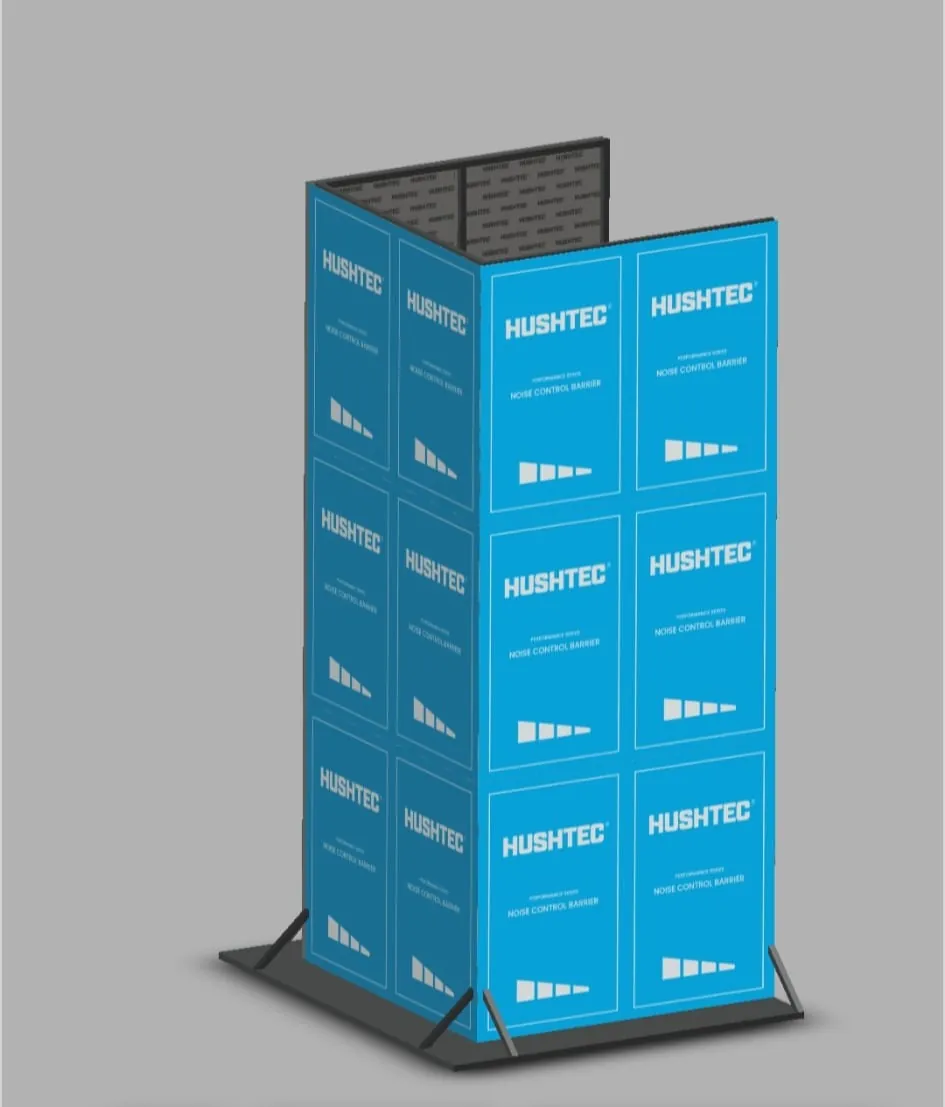
For screens above fence height, Hushtec makes RapidWall, a modular freestanding acoustic wall. It needs no ground anchors, footings or excavation, comes in standard heights of 2 m, 4 m, 6 m and 8 m (other heights on request), is wind certified to 31 m/s and has a sound insulation rating of 32 dB. Layouts include U-shape, L-shape, perimeter and corridor. Around a generator compound, a U-shape can screen three sides, provided the open side faces away from homes and the set still gets its air.
RapidWall is one of several ways to build a tall screen. Scaffold-mounted barriers, lined container walls and other freestanding systems, including some made overseas, can do the same job. For a wider comparison, see the UK temporary acoustic barrier suppliers guide.
What can you ask the contractor or the council for?
Under Section 60 of the Control of Pollution Act 1974, the council can serve a notice specifying the plant or machinery that may be used, the hours of work and the noise levels allowed. Contractors can apply in advance for prior consent under Section 61, setting out the works, the methods and the steps they will take to minimise noise.
Useful questions to ask:
- How tall is the generator or plant, and how tall is the screen around it?
- Can the plant be seen over the screen from the nearest homes, including upstairs windows?
- Does the BS 5228 noise assessment assume a barrier, and what reduction does it allow for it?
- What hours will generators run, and when will the standby generators be tested?
- Can the plant be moved, swapped for a quieter set or switched off overnight?
Before you choose or complain: checklist
- Measure or ask for the height of the top of the noise source, then add about 1.5 m as a first estimate.
- Check the view from the highest window that overlooks the plant.
- Look for gaps at joints and at the base, and check the screen extends past the ends of the plant.
- Ask for the Rw and αw, with the test standards named.
- Keep a record of when the noise happens and how long it lasts.
- Ask whether the noise can be cut at source before relying on height.
For more help, see machine noise explained, the contractor guide, the complaint guide, the noise calculator, the Learning Centre and the FAQ. If the site uses tall walls around fixed plant, our page on acoustic barriers up to 8 m covers the options in more detail.
This article is general guidance, not legal or engineering advice. For your specific situation, contact your council’s Environmental Health team or a qualified acoustic consultant.
Frequently asked questions
How high should a generator noise barrier be on a data centre construction site?
As a first estimate, Hushtec's working rule is about 1.5 m higher than the top of the noise source. A generator 2.5 m tall therefore needs a wall about 4 m high. If homes overlook the generator from upstairs windows, the wall needs to be taller or closer to the generator. A noise assessment should confirm the final design.
Why is data centre construction noise so hard to live with?
Much of it is steady plant noise rather than short bursts. Site generators, pumps, compressors and, near the end of the build, the testing of the building's own standby generators can run for long periods. A constant drone, especially with low-frequency content, is often more wearing than louder but occasional noise, and it carries further than higher-pitched sounds.
Will 2 m acoustic fence panels stop generator noise?
Usually not. If the generator is taller than the barrier, or can be seen over it from nearby windows, much of the noise passes straight over the top. Under the BS 5228 prediction method a barrier gets no credit when the plant is in clear view. Fence panels suit low plant and hand tools; larger generators need a taller screen or an enclosure.
What plant noise screening options are there for a data centre site?
The main options are acoustically enclosed generator sets, close-in screens around the plant, freestanding acoustic walls from 4 m upwards, scaffold-mounted barriers and lined shipping containers. Moving the plant away from homes, matching generator size to load and getting an early mains connection can matter as much as any screen. The right mix depends on the site layout.
Can the council limit noise from a data centre construction site?
Yes. Under Section 60 of the Control of Pollution Act 1974, the council can serve a notice specifying the plant that may be used, the working hours and the noise levels allowed. Contractors can apply in advance for prior consent under Section 61, setting out their methods and the steps they will take to minimise noise.
Sources
- Hushtec RapidWall Systems
- Hushtec: Data Center Noise Control Solutions
- Hushtec: Industrial Premium Barriers
- Hushtec: Performance Barriers
- techUK: Do data centres 'hum'?
- Environment Agency consultation: Noise Management Plan, LHR-11/12 data centre, Park Royal
- DataKustik CadnaA documentation: BS 5228
- Control of Pollution Act 1974, section 60
- Control of Pollution Act 1974, section 61
Supported by Hushtec, a New Zealand manufacturer of temporary acoustic barriers with a UK manufacturing site in Wakefield, West Yorkshire, where its Performance and Premium panels are made. How this site is funded.
Related reading
Demolition noise barrier: does a 4 m acoustic wall protect upper-floor flats?
A demolition noise barrier only works if it blocks the line of sight between the breaker or crusher and the window. For upper-floor flats, a 4 m acoustic wall on the site boundary…
Read →Top 5 temporary acoustic barrier suppliers in the UK: Echo Barrier, Siderise, BIGBEN, Hushtec and RVT Group compared
Five of the best-known names in UK temporary acoustic barriers are Echo Barrier, Siderise, BIGBEN Sound Blocker, Hushtec and RVT Group. Published ratings for their fence-mounted…
Read →How can piling noise be reduced? Perimeter barriers vs piling shrouds compared
Airborne noise from driven piling can be cut in three main ways: a tall barrier around the site perimeter, a freestanding acoustic enclosure around the pile being driven, or a shroud…
Read →