Banging and Crashing From a Works Compound Next Door? What Can You Do About Impulse Noise?
Key takeaways
- Impulse noise (sudden bangs and crashes) is easy to miss in an average reading (LAeq), so ask for maximum levels (LAmax) too.
- Under the Control of Pollution Act 1974, section 60, a council can set hours, plant restrictions and noise levels for construction works.
- Noise prejudicial to health or a nuisance is a statutory nuisance under the Environmental Protection Act 1990, section 79(1)(g), and councils must take reasonably practicable steps to investigate complaints.
- HSE reports a 14 dB reduction after a quarry lined its dump truck bodies with abrasion-resistant rubber.
- Acoustic barriers work best tall, gap-free and close to the loading point, and may need extra height to protect upper-floor flats.
A steady hum is annoying. A sudden crash every few minutes is worse, because you can’t tune it out. If a works compound near your home is loading heavy materials into trucks, you may be living with exactly that: sharp, unpredictable bangs through the working day, from 7am on some sites.
If you’re flinching at every crash, struggling to work from home, or worried about what the vibration is doing to your walls, that’s a hard way to live. You’re not being fussy. The good news is that impulse noise is something a site can measure, and something it can usually reduce.
In this article you’ll learn:
- What happened in a recent case on the Blackpool seafront
- Why average noise readings can hide the problem, and what to ask for instead
- Your rights under the Control of Pollution Act 1974 and the Environmental Protection Act 1990
- What a contractor can practically do about banging from materials handling
- A checklist to use before you make your next complaint
What happened in Blackpool?
On 9 November 2026, Central Radio North West reported on residents of two apartment blocks on Queens Promenade, Blackpool. Across the road is a works compound for the £31 million Anchorsholme Coastal Protection Scheme. Blackpool Council commissioned the scheme, Balfour Beatty is the contractor and the Environment Agency funds it.
The residents have written a formal complaint to the council. Their main issue isn’t steady background noise. It is sudden impulse noise from heavy machinery handling rock armour of up to 17 tonnes, loaded into unclad dumper trucks. They have asked for the maximum noise levels recorded at the boundary monitors to be published, for measures to reduce the impulse noise, and for the council to check whether the noise management plan is fit for purpose.
Some residents also link cracks in their walls to the work. An independent structural assessment arranged by the council concluded the works are not adversely affecting nearby properties, a finding the residents dispute.
Both sides have a case. The residents’ spokesperson said “the coastal protection scheme is vital and needs to be carried out”. The council says it meets and updates residents, has a public liaison officer, and that the contractor monitors sound during working hours. Its scheme page says vibration is monitored continuously, with work pausing if limits are exceeded. The revetment work is due to finish in summer 2027, with rock groynes following from spring 2027 to early 2028.
That’s a long time to live next to a problem, so it’s worth getting the approach right.
What is impulse noise, and why do averages hide it?
Impulse noise is a short, sudden sound, such as a bang or crash, rather than a steady one. Rock dropped onto a bare steel truck body is a classic example.
Three terms matter here:
- dB(A) is a decibel reading weighted to match how the human ear hears.
- LAeq is the steady level that carries the same total sound energy as the fluctuating noise over a measurement period. In plain terms, an average.
- LAmax is the highest level recorded during the measurement period. The loudest single moment.
Here’s the catch. A few loud bangs in an otherwise quieter hour may not lift the hourly average much. So a site can report a modest LAeq while you’re jumping out of your chair. That is why asking for maximum levels, as the Blackpool residents did, is a sensible move.
What are my rights about construction noise?
Section 60 of the Control of Pollution Act 1974 lets your council serve a notice on anyone carrying out construction works. That covers building, demolition, roads and engineering construction work. The notice can specify which plant may or may not be used, set working hours and set noise levels. Breaking it without reasonable excuse is an offence.
Section 61 is prior consent: the contractor agrees its methods, hours and noise controls with the council in advance. The council must decide within 28 days. Working to a consent is a defence to a section 60 prosecution, but the consent must state that it is not, by itself, a defence to proceedings brought under section 82 of the Environmental Protection Act 1990.
Statutory nuisance is noise that is “prejudicial to health or a nuisance”, under section 79(1)(g) of the Environmental Protection Act 1990. Councils must take reasonably practicable steps to investigate complaints from people living in their area. If they agree a statutory nuisance exists, they must serve an abatement notice, although for noise they may first try other steps to get it stopped.
Best practicable means (BPM) means the reasonably practicable steps a contractor should take to minimise noise, considering local conditions, technical knowledge and cost. Where the noise comes from industrial, trade or business premises, the person responsible can defend a prosecution for breaching an abatement notice by showing BPM was used. In England, the approved code of practice is BS 5228-1:2009+A1:2014 for noise, with BS 5228-2 for vibration.
What hours are typical?
It depends on what’s agreed for the site. North Yorkshire Council, for example, recommends noisy work 8am to 6pm on weekdays, 8am to 1pm on Saturdays and none on Sundays or bank holidays. Some schemes publish their own hours. The Anchorsholme scheme’s published hours are 7am to 7pm, Monday to Friday. Ask what has been agreed for your site, and log anything outside it.
Who should I contact, and what should I ask for?
Start with the contractor, then go to the council if that doesn’t work. North Yorkshire Council gives the same advice.
| Your concern | Who to contact first | What to ask for |
|---|---|---|
| Sudden bangs from loading or handling | Site manager or public liaison officer | Monitoring results (LAeq and LAmax) for the times you logged; what’s being done about impact noise |
| Noise outside agreed hours | Site manager, then Environmental Health | The agreed hours; whether a section 60 notice or section 61 consent is in place |
| Possible damage from vibration | Contractor’s vibration contact | Vibration monitoring results; a structural survey of your property |
| No response, or you disagree with the answer | Environmental Health, copying your ward councillor | A formal investigation under the Environmental Protection Act 1990 |
When the council is also the scheme’s client, as in Blackpool, Environmental Health still has its own duty to investigate. Put everything in writing and keep copies.
What can a contractor do about banging from materials handling?
Quite a lot, and the most effective fixes deal with the impact itself. Here are the main options.
Reduce the drop
Commonly used for: loading rock, rubble or scrap into trucks and skips.
Pros: costs little; tackles the bang at source. HSE’s general advice is to reduce the height and speed of falling objects.
Cons: can slow loading; depends on operator discipline.
Line the truck bodies
Commonly used for: dumper and dump truck bodies, hoppers and chutes.
Pros: HSE reports a quarry cut noise by 14 dB after lining its 20-tonne dump truck bodies with abrasion-resistant rubber, where first loads onto bare metal had produced 96 dB(A).
Cons: that was one operation, with figures supplied by the lining’s maker, so results will vary. It may not suit every vehicle.
Move or schedule the activity
Commonly used for: the noisiest loading tasks.
Pros: placing the loading area as far from homes as practical, and avoiding the first and last hours of the day, eases the impact.
Cons: compound space is often tight, especially on a seafront.
Put a proper acoustic barrier around the loading area
Commonly used for: fixed or semi-fixed activities like loading bays, crushers and generators.
Pros: reduces noise for everyone behind it, all day.
Cons: only works if specified properly. A low fence-line barrier won’t help much if you look down on the work from upper floors.
Is an acoustic barrier enough?
On its own, often not. Combined with quieter handling, it can make a real difference. What matters:
- Height: it must block the line of sight from your windows to the loading point. Upper floors may need a taller wall. Our guide on how high an acoustic wall needs to be explains how to check.
- No gaps: sound leaks through joints and under the base.
- Close to the source: the nearer the barrier is to the activity, the better it works.
- Absorptive face: sound absorption (rated as αw) describes how much sound a surface soaks up rather than reflects. An absorptive face stops noise bouncing back towards other homes.
Rw is a laboratory rating of how much sound a panel blocks; higher is better. Lab Rw is not the same as the reduction you’ll get on site, because sound diffracts over the top and around the ends of a barrier. For upper-floor flats, see our article on whether a 4 m wall protects upper floors.
Where does Hushtec fit in?
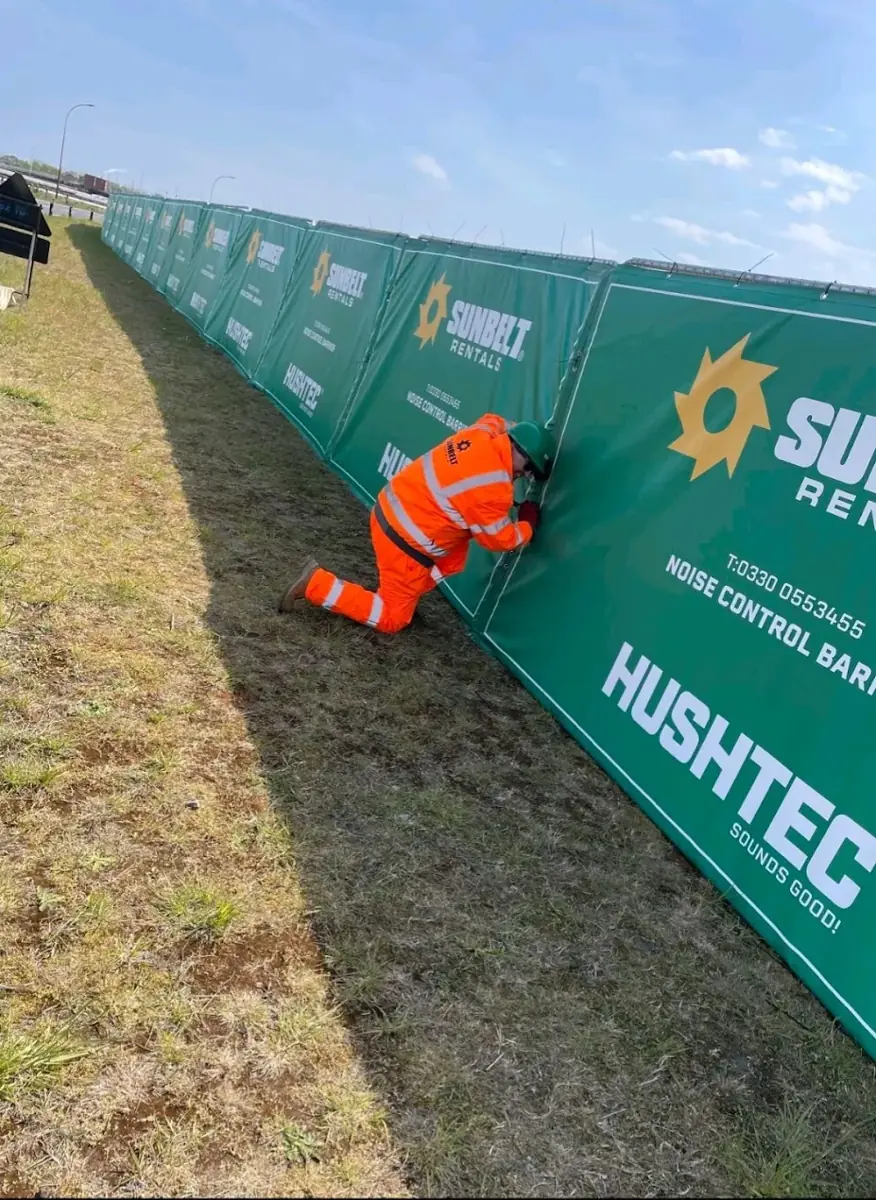
This site is supported by Hushtec, a New Zealand manufacturer of temporary acoustic barriers with a UK manufacturing site in Wakefield, West Yorkshire, where its Performance and Premium panels are made.
Hushtec’s panels are rated at Rw 26 dB (Performance), Rw 32 dB (Premium) and Rw 38 dB (Signature Series). Its RapidWall system is a freestanding acoustic wall available up to 8 m high, with no ground anchors or footings, which can suit sites where digging footings isn’t practical. It is one of several taller-wall options; others include scaffold-mounted barriers. Real-world results depend on layout, and a barrier works best alongside quieter handling. See acoustic barriers up to 8 m for more.
Before you act: checklist
- Have you logged the date, time and description of each bang, and how it affected you?
- Do you know the site’s agreed working hours?
- Have you asked the contractor for monitoring results, including LAmax, for the times you logged?
- Have you asked what’s being done about impact noise: drop heights, lined truck bodies, location of loading?
- If you’re worried about damage, have you asked for vibration data and a survey?
- No progress? Write to Environmental Health with your log, and copy in your ward councillor.
To get organised, start with our guide to recording noise evidence, use the complaint guide to structure your letter, and try the noise calculator. There’s more in the Learning Centre and FAQ, or ask for assistance.
This article is general guidance, not legal advice. For your specific situation, contact your council’s Environmental Health team or a qualified adviser.
Frequently asked questions
What is impulse noise from a construction site?
Impulse noise is a short, sudden bang rather than a steady sound. On a works compound it often comes from dropping heavy materials, such as rock, steel or rubble, into skips or truck bodies, or from tailgates slamming. Because each bang is brief, an average noise reading can look modest even when the bangs are startling and frequent, so ask for maximum levels as well.
Can I ask a contractor for its noise monitoring data?
Yes, you can ask. In the Blackpool case, residents asked for the maximum levels recorded at the boundary monitors to be published. If the contractor won't share them, ask your council's Environmental Health team to look at them. Ask for both average levels (LAeq) and maximum levels (LAmax) at the monitor nearest your home, for the times you logged disturbance.
What hours can a works compound operate?
It depends on what has been agreed for that site. Some councils, such as North Yorkshire, recommend noisy work from 8am to 6pm on weekdays and 8am to 1pm on Saturdays, with none on Sundays or bank holidays. Some schemes publish their own hours, which may be longer. Ask the contractor and your council which hours apply to your site.
Will an acoustic barrier stop the banging from rock handling?
It can reduce it, but only if it is properly specified. The barrier needs to be tall enough to block the line of sight from your windows to the loading point, with no gaps at joints or the base, and placed close to the activity. Upper-floor flats may need a taller barrier, and the best results usually come from combining a barrier with quieter handling methods.
The council is also the client for the works. Can Environmental Health still help?
Yes. Environmental Health still has a duty to take reasonably practicable steps to investigate complaints from residents. Put your complaint in writing with your noise log attached, and ask what controls have been agreed for the site. If you feel it is not being handled properly, copy in your ward councillor and keep a record of every response.
Sources
- Central Radio North West: Residents believe works compound is causing cracks in walls of their homes (9 November 2026)
- Blackpool Council: Anchorsholme Coast Protection Scheme
- Control of Pollution Act 1974, section 60 (legislation.gov.uk)
- Control of Pollution Act 1974, section 61 (legislation.gov.uk)
- Environmental Protection Act 1990, section 79 (legislation.gov.uk)
- Environmental Protection Act 1990, section 80 (legislation.gov.uk)
- The Control of Noise (Code of Practice for Construction and Open Sites) (England) Order 2015, article 2
- GOV.UK: Noise nuisances – how councils deal with complaints
- North Yorkshire Council: Noise from construction and demolition sites
- HSE: Reducing noise when loading dump trucks
- HSE: Avoiding impacts
- Scottish Government Noise Mapping: Explanation of noise terms
- Hushtec RapidWall Systems
Supported by Hushtec, a New Zealand manufacturer of temporary acoustic barriers with a UK manufacturing site in Wakefield, West Yorkshire, where its Performance and Premium panels are made. How this site is funded.
Related reading
Roadworks Diversion Lorries Keeping You Awake? What Can You Do?
Noise from traffic on a signed roadworks diversion is excluded from statutory nuisance law, so your council's Environmental Health team usually can't act on it. Take diversion routing…
Read →What Can You Do About 24-Hour Tunnelling Noise Near Your Home?
If construction or tunnelling noise runs through the night near your home, keep a dated log, raise it with the contractor first, then contact your council's Environmental Health team.…
Read →Why Piling Noise Is Getting Louder in UK Cities — and What Residents Can Do
Driven precast concrete and steel piling remain the single loudest routine construction activity in UK cities, with unmitigated levels of 95–105 dB at source. Rising basement and…
Read →